 THE
FUNDAMENTALS
OF FICTION
WRITING
THE
FUNDAMENTALS
OF FICTION
WRITING
 THE
FUNDAMENTALS
OF FICTION
WRITING
THE
FUNDAMENTALS
OF FICTION
WRITING
Should authors simply follow the instructions herein because these are the rules for fiction writing?
“All receive advice. Only the wise profit from it.” —Syrus
A. The mindless acceptance of poorly thought out writing advice, ill considered do's and don'ts without reason or explanation, promotes only blithe autocratic misunderstanding and hack ineptitude.
Adding a broad assertion to a list of broad assertions does not make any of them true if, in actuality, they are not to begin with. Hence, arbitrary commandments without reasons ought to be suspect. Rather, it is of greater value to understand the whys and wherefores.
For if it is, indeed, true that there is, after all, no disputing tastes, just as goes that annoying vapid old canard, then Esthetic value at all, much less Literary criticism, is entirely and intrinsically vacuous, null and void, actually worse off than xeno/exo/astrobiology, the famous discipline without a subject, because even until extraterrestrial life forms are ever discovered, at least said remains at all conceivable. But if beauty is, indeed, merely in the eye of the beholder, entirely subjective, then, objectively, it would seem that there can be nothing to sensibly discus, let alone ever find in all the universe.
But then, meaning, including value, none the least morality and esthetics, are Phenomenal and contingent experience no less than comprehension and reflection.
Indeed, there may be hope that the arts are not completely arbitrary, because of cutting edge studies in musicology, defining the characteristic patterns in what makes a melody pleasing. For this suggests that the preferences of taste are only partially personal and idiosyncratic, certainly in large part cultural, but also confirm that taste, after all, is an aspect of character, psychology, hence partially biologically innate and in common to the human species and intersubjective. Otherwise, art would never evoke, much less communicate, meaning and value.
So, how does any of this apply to the art and discipline of fiction writing? The answer is in the suggestion that the age old dictums of drama and the writing discipline, are not, after all, valueless, but simply insufficient, incomplete like the fixed biological component of musical preference, a manifest beginning even if not the last word.
In science exceptions constitute refutation. And yet, even then, verisimilitude, imprecision approaching truth, may yet persist, as with Newtonian gravity until anything better came along, despite observations in contradiction, for the indispensable uses it still had. Or, more saliently, psychology remains, even to this day, hit or miss, frustratingly imprecise for testable psychotherapeutic predictions, and yet viable hypothesis of profound explanatory significance. Moreover, much of the most sophisticated psychology remains manifest in the sagacity of great novelists, a sensibility. Indeed, what is drama, save lies pointing to some truth, however obvious or else elusive, of the human condition? Indeed, such are the age old dictums of drama and the writing discipline, always subject to exceptions, because life is the study of exceptions, because there is always more to it, not less, the art, soul and genius, along with the indispensable discipline of fiction writing, that, nevertheless, soulless, churns out only hack.
After all, allegory, as in fiction writing, endures as the most elusive of techniques, constantly seeming to be other than what it is, redolent with the ambiguity and uncertainty of the world depicted.
And all of that is only why any sort of genuine writer must strive for competence, ever standing at the ready to pick apart technique in order to be able to exchange criticism, meaningfully, so as to however grow in awareness and appreciation of how and why any fiction at all in whatever medium ever held their attention and reached them, and how to apply the same principles and techniques as a fiction writer oneself.
And make no mistake. These FAQ pages, text Onsite plus links Offsite, begin with and endeavor to adequately cover the utter fundamentals indispensable to capable fiction writing at all, let alone the invitation to collaboration herein.
Indeed, the only really sound reason for any perhaps more advanced aspiring fiction writer not to use this free resource or some equivalent thereof, would be that these pages only repeat what one already knows and understands without helping or adding anything much more. But not otherwise. So consider yourself warned.
Writing, much as with photography, may often turn out to be easy to do at all, often badly, but difficult to do well.
An adequate author can derive a great story even from automated plot generators and the like. Conversely, a sufficiently clumsy writer can reduce the best, most original ideas into utterly unreadable pabulum.
Good writing is more often the product of sustained effort and practice, and seldom comes out right on the first try.
: Where does the creative soul of inspired art emerge from the mere facility of hack craft?
 Top Ten Quik-Hints

The Four C's are Conflict, Complication, Crisis and Climax. -Also contradiction...
 Q.
Q.
A.
Conflict is everything! Indeed, creating conflict escalating on many levels with difficulty from any sort of obstacle or complication is sine qua non for any sort of
tension,
every
Technique
of
Suspense
plotting and
anticipation,
even discomfort and
aversion, to sustain
pathos
and interest in a good story.
Conflict on every
level
is the engine that drives stories. And
Dialectic
dialogue
proffers the
meaningful
dramatization of
controversy
and values and intriguing problem to solve. Otherwise, the world stays at rest.
Conflict sensitivity is wariness of how differing interests come into conflict,
enabling both reporters and
fiction writers to find their stories. Find
conflict and
drama
follows.
sine qua non for any sort of
tension,
every
Technique
of
Suspense
plotting and
anticipation,
even discomfort and
aversion, to sustain
pathos
and interest in a good story.
Conflict on every
level
is the engine that drives stories. And
Dialectic
dialogue
proffers the
meaningful
dramatization of
controversy
and values and intriguing problem to solve. Otherwise, the world stays at rest.
Conflict sensitivity is wariness of how differing interests come into conflict,
enabling both reporters and
fiction writers to find their stories. Find
conflict and
drama
follows.
Conflict sensitivity is mindful wariness of how differing interests come into conflict, enabling reporters and fiction writers alike, to find their stories. Find the conflict, and drama follows. Sensitivity Analysis is any process to determine how different increments of some specific independent variable will impact a particular dependent variable under a given set of assumptions and how sensitive a model is to alteration in the parameters of the model. In other words: plot variation in futurological or other scenario planning, equilibrium, and their hypothetical probability and likelihood or: plausibility. With background established, disequilibrium sets the story into motion.
Basic conflict types include: setting providing obstacles of situation, circumstances, predicament, objectively and subjectively, activity, enterprise, initiative, endeavor or operant behavior motivated by whatever desired or undesired outcomes, struggles of influence or manipulation between characters, and karmic destiny: predictable outcomes, particularly as of bad karma, unfolding as inexorably driven by inflexible fixed attitudes, position or POV, in short: dramatic failure of growth.
Type of conflict is part of what determines genre. Writing : Plot by by Damon Knight [summarized] deals with plot problem types as classifiable by their motivated goals put forth or endings, while 'A Guide to Mystery Genres' classifies by tone and details of setting, George Polti's classic and still controversial '36 Dramatic Situations (plus one)' classifies inciting incidents or circumstances that will, no doubt, make for an exciting mix and match with the 20 Master Plot Exercises. And Wise Women Discuss—Plot! lists the different basic plots, dramatic structure as defined by interconnection among the various levels of conflict with different obstacles. -Including, of course, conflict with an enemy, the more interesting, however, if the enemy and protagonist share any mixed feelings. Indeed, any good story needs levels and layers of interpersonal conflict even among friends. As with Spock and Bones, probing and bickering. And, especially, as with Spock, inner conflict, ambivalence and angst, with all of the obstacles life provides us to carry with us, inside.
By every Technique of Suspense plotting, the rising tension and of dramatic conflict signifies that the resolution of whatever the central problem is such as to increasingly press character(s) inevitably to take action in struggle with whoever or whatever the antagonist in some way that must one way or another bring the very values of said character(s) into question for them. Or, most dramatically, an attempt at howsoever the wiser course may instead press a character into conflict on every level with their own motivating values for which they will be compelled to sacrifice the easier way because the moral course and the more difficult among free willed choices may so often coincide.
Characters need to be at all up to their challenges, but only barely. Don't be nice to your characters. No Powderpuff Pitty-Pat! Prolong the Agony by making life difficult so as to motivate characters. Even pander to vicarious wish fulfillment, but also inspire pathos, anticipation, by every Technique of Suspense plotting, even dread and the outright discomfort of sheer aversion. Stir any range of emotions and force the reader to empathize, to feel. That's what makes for good entertainment, a real gripping page turner.
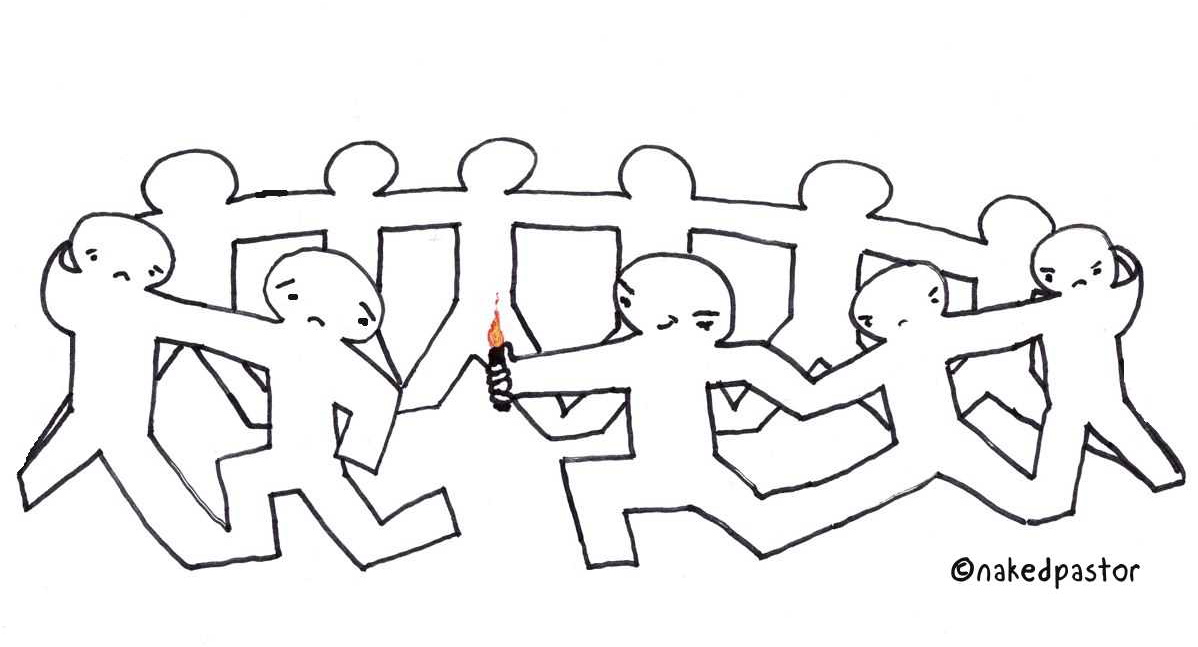
To propel conflict, the Protagonist and Antagonist characters must display complementary psychologies along 8 basic parameters, such that the motivating desires and intentions of the Protagonist are bound to arouse the motivating fears of the Antagonist, and vice versa. Throughout the plot, the tension and pathos, even discomfort and aversion, of every Technique of suspense in plotting, building tension and anticipation, are all heightened as thing are made more difficult, the personal emotional stakes are raised, and character growth is pressed by worsening complications for an active protagonist, definitely including onstage sex! Virtually all relationships of whatever kind begin with some sort of first discovery, romance even courtship, so to speak, even "the honeymoon," but inevitably and come into conflict on different levels, friction which is normal and even healthy, and in order to survive must reach acceptance in order to commit to substantive cooperation and collaboration.
Plausible characters, like unto real people, require adequate motivation for their deeds and dialogue. Drama is people doing amazing things for very good reasons. But melodrama is just people doing amazing things for bad or utterly nonexistent reasons. In real life, as in drama, true character is revealed in conflict and under pressure to lower ones guard and show, demonstrate, what we are really made of and ever grow.
Because conflict on every level, or contradiction, is more than crisis, indeed, not merely an event in the first place, but, again, karmic, a condition, a relationship. Conflict pressing difficult free choices is more than crisis or combat wherein the path, however arduous, nevertheless remains fairly clear. Characters develop out of situation and plot ideas emerge from characters in different situations and the actions undertaken because of their relationships and conflict on many levels, the friction entailed as characters come into contact.
Theme being whatever central question or inquiry, must correlate with some dramatic issue that must be compelling, credible and untenable conflict of values escalating naturally through increasingly high-stakes of any problematic situation. Drama requires characters each with whatever their own stake in the issues, decisions, dire free choices to make and the looming consequences thereof. And, to build tension and maintain interest and exploit every Technique of Suspense plotting, all attempts to back out must deteriorate and fail, but without such glaring plot holes as blithely overlooked or ignored obvious opportunities.
Navigate the various possible paths and dead ends and to find stories always dig deeper for insight to the struggle. Throughout the plot, the tension and pathos, even discomfort, outright aversion and every Technique of Suspense plotting and anticipation, are all heightened as things are made more difficult, the personal emotional stakes are raised, the free choices harder, and character development is pressed by worsening obstacles and complications for an active protagonist, definitely including onstage sex!
Stories are made memorable not merely in whatever empathy or curiosity merely as to the plot situation, but because of the reader or audience relationship, actual motivated feelings elicited for or even against the characters.
Whistle
Blowing
- the psychodynamics of
conflict
When friendship is not good for your mental health
Frequently, the self conscious illusion of individual will is only the burden of responsibility in hindsight, an artifact of the personal narrative facilitating growth. Some say that one becomes addicted to shame when another's heart is closed to one, because, however excruciating, the sheer megalomania of taking the blame protects one from the ugly truth that we really have no control over others and the universe or God. We can't make either love us or, ultimately, even protect those who do. Put more simply, then, and in complete good faith, powerlessness, the impotent helplessness of the human condition is terminally demeaning. And beyond direct action, our influence upon others may often be even the more misguided and deluded.
Life can only be lived forwards, but only understood or recognized in hindsight. Indeed, do we consider our options and consciously take action, or do our actions simply come upon us as we react to situation, and only then rationalize afterward? People often make their most important decisions with their heart but only then rationalize intellectually. Hence, Problem Solving and Justification are reciprocal functions, and one must be shaped to rationalize the other, with integrity or else into hypocrisy. The inner journey must match the outer journey, beginning from the Emotional Disturbance that is is characters internal corollary to it's trigger, the out-of-whack event, or vice versa. The audience must empathize with a somehow at all sympathetic protagonist facing any worthy antagonist, Villains People Love to Hate, presenting enough of an obstacle to keep the outcome in doubt. Or an entire plot may be derived from any character's emotional core, as in a tragedy, hamartia, the blind error of maladaptation by a character inconveniently mismatched to circumstances or situation (in contrast to the aspect of the hero as more opportunely, appropriately and better equipped, skilled or tempered for whatever challenge at hand), the protagonist's greatest personality flaw, error, or, worse, their greatest virtue, but perhaps in disproportion, leads only to misfortune.
For any character's free choice of strategy will be determined not only by their POV, situation or even entirely mechanistic particular involvement in whatever phase of any process considered, but also defined, guided and constrained by values, into somehow or other principled behavior. And even the loftiest personal or ideological motivation and most admirable character trait can miss the mark, go astray and awry even upon the proverbial road to Hell that is paved with good intentions, to inspire and then culminate in a cascade of ill considered if not foul deeds outright, tribulation, dissolution, downfall or comeuppance, ruination and disaster. Indeed, even if thankfully in any somewhat less calamitously heroic proportion, ordinary flawed folk may blindly err, and often prove so much their own worst enemies, that their "inner villain" may provide enough of an obstacle all on it's own to sustain tension and pathos for every Technique of Suspense plotting and anticipation, even discomfort and aversion, by keeping the outcome in doubt.
Genial good listeners may be pleasant to be acquainted with in real life, but in dramatic writing such characters are poisonously dull. Know your conflicts and contradictions on every level, motivations, problems and dramatic obstacles, in order to sustain the narrative.
Unless the story is driven entirely by a completely external situation, plotting depends upon differing motivated goals ever put forth for the building blocks of interpersonal conflict on different levels between characters. With no "prods," the story runs bland. Hostility, mistrust and polarization are among the many aspects attendant upon conflict on every level pressing difficult free choices, which is more than a simple and civil disagreement or merely an event, more than crisis, but karmic, a condition, a relationship.
Albert Bandura“People's level of motivation, affective states, and actions are based more on what they believe than on what is objectively the case.” -
Just such conflict even on levels beneath the surface TEXT and CONTEXT may, nevertheless, emerge through subtext, What Lurks Beneath, shown by way of each of the senses in setting, action and atmospheric tone along with the Subtle and Delicate Art of Doublespeak dialogue, may either harmonize with text, or in true Method subtext, even disagree with text, subtly, so as to draw attention into a deeper vein or level of conflict by being subtly wrong, to show or evoke characterization, wherein motivation should be apparent, even through thoughts, however expository. -Even ambiguity, which is the level of conflict in meaning as sought for in Literature (as distinguished, narrowly defined and signified by the much vaunted capital "L") .
Each event in sequence that follows from motivated character action consistent with background, must in turn initiate from observable proximate stimulus unless entirely emerging from inner life, and, either way, rather than simply remaining mysterious, known only the mind of the character, must one way or another be shown intelligibly to the audience, even if to none of any other characters; either way, in turn, quite probably another vitally important plot point. Whenever the cause and effect chain ever omits such links, expect plot holes stumbling amid succession of unrelated events.
Conflict in it's many levels, or contradiction, pressing difficult free choices, is more than crisis and not merely an event, but karmic, a condition, a relationship. Conflict pressing difficult free choices goes beyond crisis or combat wherein the path, however arduous, nevertheless remains fairly clear. Characters develop out of situation and plot ideas emerge from characters in different situations and the actions undertaken because of their relationships and many levels of conflict, the friction entailed as characters come into contact. The dramatic efficacy of revealing and motivated subtext is in frustrated desire, giving rise to need and ingenuity. Drama is the gripping and engaging tension-laden presentation of conflict on many levels, whether or not the storyline is even believable. Drama is conflict pressing difficult free choices on many levels, as inherent to situation, conflict on every level, or contradiction, beyond mere crisis, being, as it is, more than merely an event, but karmic, a condition, a relationship. Alas, however, beware! poor staging or presentation of conflict dissipates inherent drama.
is the function of the dramatic obstacle?
“What would there be in a story of happiness? Only what prepares it, only what destroys it can be told.” — André Gide
A.
An obstacle is whatever element or circumstance arising to prevent or impedes or prevents the character from whatever motivated action towards whatever goals as ever put forth. Without and obstacle, their is nothing to resolve and no way to draw out any drama.The purpose of dramatic obstacles is that the difficult struggles of a character confronted with an obstacle provides so many levels of conflict, tension and pathos, even discomfort and aversion of every Technique of Suspense plotting and anticipation, all to prolong the foreplay. It all turns upon the reason why. And it was James Blish who suggested that the best way to derive plot from premise begins by determining: who gets hurt? -as a consequence, by way of any sort of logical or causal conclusion...
Because, by every Technique
of Suspense plotting, the rising tension and of dramatic conflict signifies that the resolution of whatever the central problem is such as to increasingly press character(s) inevitably to take action in struggle with whoever or whatever the antagonist in some way that must one way or another bring the very values of said character(s) into question for them. Or, most dramatically, an attempt at howsoever the wiser course may instead press a character into conflict on every level with their own motivating values for which they will be compelled to sacrifice the easier way because the moral course and the more difficult among free willed choices may so often coincide.Complications build upon, worsen, accumulate and intensify conflict. But for the pressure to thusly mount, also requires time and frustration from resolution. Retarding plot elements which delay or prolong the action are obstacles, while retrogressive elements which divert action away from its goals as ever put forth are subplot.
Prolong the Agony by making life difficult so as to motivate characters. Even pander to vicarious wish fulfillment, but also inspire pathos, anticipation, every Technique of Suspense plotting, even dread and the actual discomfort of sheer aversion. Stir any range of emotions and force the reader to empathize, to feel. That's what makes for good entertainment, a real page turner.
All manner of dramatic obstacles may obstruct the anticipated attainment of a desire, whatever that might be, even such as love for onstage sexual tension (as, for a familiar example, on the popular 'Moonlighting' TV show) or such tension as is generated by the need to escape from a threat for every Technique of Suspense plotting. Combat is predicated upon the most dire and deliberate threat. Or any contest or game poses an intentional obstacle, arbitrarily, before whatever prize or motivated goals ever put forth, if only the thrill of victory.
/ [eu]stress“Thoughts are the shadows of our feelings - always darker, emptier and simpler.” — Friedrich Nietzsche
But all manner of situations, even quite unforeseen, may present any range of obstacles, from an empty bread box standing in the way of the perfect sandwich, a bad hair day spoiling romance, misunderstanding threatening love, perplexing riddles and secrets denying truth, engineering limitations in the path of invention or a natural disaster barring very survival.
Or, beyond all such approach and avoidance, characters may even grow by rising to new challenge, often sadly evaded by the complacent. And in fiction obstacles or problems make for dramatic tension, which, when it happens in reality may sometimes be known as creative tension.
Misdirection, whether error circumstantially and honestly, by deliberate manipulation or even hamartia and self-deception, is key in moving from promise to catastrophe. And frequently, the self conscious illusion of individual will is only the burden of responsibility in hindsight, an artifact of the personal narrative facilitating growth.
Some say that one becomes addicted to shame when another's heart is closed to one, because, however excruciating, the sheer megalomania of taking the blame protects one from the ugly truth that we really have no control over others and the universe or God. We can't make either love us or, ultimately, even protect those who do. Put more simply, then, and in complete good faith, powerlessness, the impotent helplessness of the human condition is terminally demeaning.
And beyond direct action, our influence upon others may often be even the more misguided and deluded.
Life can only be lived forwards, but only understood or recognized in hindsight. Indeed, do we consider our options and consciously take action, or do our actions simply come upon us as we react to situation, and only then rationalize afterward? People often make their most important decisions with their heart but only then rationalize intellectually.
Hence, Problem Solving and Justification are reciprocal functions, and one must be shaped to rationalize the other, with integrity or else into hypocrisy. The inner journey must match the outer journey, beginning from the Emotional Disturbance that is is internal corollary to it's trigger, the out-of-whack event, or vice versa. The audience must empathize with a somehow at all sympathetic protagonist facing any worthy antagonist presenting enough of an obstacle to keep the outcome in doubt. Or an entire plot may be derived from any character's emotional core, as in a tragedy, hamartia, the blind error of maladaptation by a character inconveniently mismatched to circumstances or situation (in contrast to the aspect of the hero as more opportunely, appropriately and better equipped, skilled or tempered for whatever challenge at hand), the protagonist's greatest personality flaw or, worse, their greatest virtue, but perhaps in disproportion, leads only to misfortune.
For any character's at all free choice of strategy is defined, guided and constrained by values, into somehow or other principled behavior. And even the loftiest personal or ideological motivation and most admirable character trait can miss the mark, go astray and awry even upon the proverbial road to Hell that is paved with good intentions, to inspire and then culminate in a cascade of ill considered if not foul deeds outright, tribulation, dissolution, downfall or comeuppance, ruination and disaster. Indeed, even if thankfully in any somewhat less calamitously heroic proportion, ordinary flawed folk may blindly err, and often prove so much their own worst enemies, that their "inner villain" may provide enough of an obstacle all on it's own to sustain tension and pathos, even discomfort and aversion, of suspense and anticipation by keeping the outcome in doubt.
For with freedom at all, there must be hard choices, not just bogus alternatives, dilemmas, between the greater good, the lesser evil, or both in one, to engender conflict on many levels. Dramatic conflict various levels is sustained by opposing goals put forth from differing motivations that struggle beneath the surface in subtext, characterization and Conflict Handling styles.
All of that is what helps to make fiction compelling.
A disruption such as the inciting incident or out-of-whack event, is that which changes the situation bringing about conflict as a consequence. A character confronted with any sort of obstacle provides conflict. Indeed, in order to heighten conflict on every level, tension and pathos, even discomfort and aversion, of suspense and anticipation or doubt, as well as the premise, a story may also incorporate an opposing or contradictory Counter Premise or Antithesis.
Type of conflict is part of what determines genre. Writing : Plot by by Damon Knight [summarized] deals with plot problem types as classifiable by their motivated goals put forth or endings, while 'A Guide to Mystery Genres' classifies by tone and details of setting, George Polti's classic and still controversial '36 Dramatic Situations (plus one)' classifies inciting incidents or circumstances that will, no doubt, make for an exciting mix and match with the 20 Master Plot Exercises. And Wise Women Discuss—Plot! lists the different basic plots, dramatic structure as defined by interconnection among the various levels of conflict with different obstacles. -Including, of course, conflict with an enemy, the more interesting, however, if the enemy and protagonist share any mixed feelings. Indeed, any good story needs interpersonal conflict even among friends. As with Spock and Bones, probing and bickering. And, especially, as with Spock, inner conflict, ambivalence and angst, with all of the obstacles life provides us to carry with us, inside.
All else in the logic of plotting scenes readily follows from pertinent decisions what need be shown regarding motivated characterization and conflict on many levels with dramatic obstacles.
Q. What are the possible outcomes of conflict?
A. Many people often tend to interact superficially for the comfort of denial, to avoid deeper and more troubling issues, focusing upon the trivial they neglect the meaningful, a veritable living death and struggle of running ever harder just to keep up with standing still. But is the difficulty of conflict and contradiction on any level at all, truly avoided in this way? No, for such evasion is merely the exercise of inner conflict, internalized by denial.
“People's level of motivation, affective states, and actions are based more on what they believe than on what is objectively the case.” -
Albert BanduraBy dwelling upon the small mindedly trivial and picayune rather than drama or controversy, only petty bickering arises because the crucial impetus to however grow and progress has effectively been hobbled. And so, in real life, the tension rises all the more, but in fiction only if the reader or audience can be brought to care.
Thus, in fiction no less than in reality, we may do best to welcome the rich and varied levels of conflict so long as they may be important or meaningful, even thematic. A good process aims to resolve the decisive (and divisive) issues and clear them out of the way. Sometimes pressing important concrete motivated goals put forth provides the impetus to move along past conflict. But this tends to reduce drama, an effect while generally soothing in reality and the sooner the better, by the same token harmful to fiction and to be put off as long as possible, because drama is plot structured so as to intensify the tension and pathos, even discomfort and aversion of suspense and anticipation from conflict on every level until reaching climax and resolution, dramatic tension, which, happening or cultivated in reality may sometimes be known as creative tension.
No Powderpuff Pitty-Pat! Throughout the plot, the tension and pathos, even discomfort and aversion, of suspense and anticipation is heightened as thing are made more difficult, the personal emotional stakes are raised, and however character growth is pressed by worsening complications for an active protagonist, definitely including the sexual tension onstage! Virtually all relationships of whatever kind begin with some sort of first discovery, romance even courtship, so to speak, even "the honeymoon," but inevitably and come into conflict on many levels, friction which is normal and even healthy, and in order to survive must reach acceptance in order to commit to substantive cooperation and collaboration.
Prolong the Agony by making life difficult so as to motivate characters. Even pander to vicarious wish fulfillment, but also inspire pathos, anticipation, suspense even dread and even the discomfort of sheer aversion. Stir any range of emotions and force the reader to empathize, to feel. That's what makes for good entertainment, a real page turner.
Two possible consequences especially on the level of external conflict, most especially violence, are dominance or annihilation, the outcome determining the victor and the defeated. But other possibilities include stalemate, compromise entailing reciprocal sacrifice, some zero-sum solution, or, instead, the discovery of common interests behind the drama or even some win-win solution. Indeed, any plot-oriented Science Fiction story may even climax in the resolution of an engineering "contradiction." Or else, especially in so far as conflict is precipitated by disagreement or opposing values, the outcome may resolve or at least alter conflict via reevaluation and change in perception, learning, growth. All myriad possibilities leaving the outcome all the more in doubt in order to raise tension and pathos of suspense and anticipation.
Indeed, as Mary Parker Follett anticipated so well ahead of her time, conflict is to be found at the root of both deadlock and accomplishment, even reconciliation, in social reality and work, even exactly as in by now standard dramatic formulae of redefinition of the conflicting positions and even of new goals over false. -As opposed to the needless (melo)drama of pointless conflict. Indeed, for drama into tragedy, will suffice that the characters consume their resources without resolution of conflict. Or, indeed, to find comedy, something astonishing must occur to facilitate a happy ending also human and revelatory of character under the situation with which we all struggle.
For likewise, and sometimes in parallel or counterpoint with just such outer conflict, there are also a number of possible developmental outcomes of crisis, however growth from inner conflict, even proportionally. And as well the premise, a story may also incorporate an opposing or contradictory Counter Premise or Antithesis, even requiring it's own persuasive spokesperson, or obstacle character.
 Indeed, Gandhi regarded
conflict in it's myriad
levels as neither inherently good nor evil, but a
natural form of human interaction and a tool for either good or ill.
And Martin Luther King regarded
Creative Tension
as key to
Gandhian
conflict management,
personal and societal
growth,
i.e.,
societal positive disintegration
from conflict resolution,
synthesis and
even
reconciliation, making nonviolent resistance more than merely a tool for confrontation,
also serving to mobilize support for the cause so that the resultant
conflict
motivates everyone to take a stand, on one side or the other.
A
"mentally and spiritually aggressive" technique not only avoiding "external
physical violence," but also "seek[ing] to avoid internal violence [to the]
spirit."
Indeed, Gandhi regarded
conflict in it's myriad
levels as neither inherently good nor evil, but a
natural form of human interaction and a tool for either good or ill.
And Martin Luther King regarded
Creative Tension
as key to
Gandhian
conflict management,
personal and societal
growth,
i.e.,
societal positive disintegration
from conflict resolution,
synthesis and
even
reconciliation, making nonviolent resistance more than merely a tool for confrontation,
also serving to mobilize support for the cause so that the resultant
conflict
motivates everyone to take a stand, on one side or the other.
A
"mentally and spiritually aggressive" technique not only avoiding "external
physical violence," but also "seek[ing] to avoid internal violence [to the]
spirit."
So, in King's view, real life progress actually depends very much upon meaningful controversy and true real life drama, what matters deeply, the struggle for meaningful values in action that matters, to which motivated conflict in every myriad level, of course, is central for meaningful social controversy!
And, whereas the vicissitudes of unnecessary and irresolvable conflict generated simply by tone, manner, style of communication and behavior, tend only to melodrama, by contrast drama also requires anything important at stake, even a polemical point, and hence may even unfold constructively, in life as in art. But, likewise, the outcome can be kept in doubt, as the mounting destructive passions of pointless escalating conflict become ever harder to resolve. Thus, conflict will never truly or long be forestalled, but only fester, by suppressing the issues or silently swallowing disagreement or, indeed, by rejecting, on whatever dishonest, timid, misguided or self serving principle or sycophantic taboo, the practice of argument. The truth will out! Indeed, as Gandhi said, first they ignore us, then they trivialize and mock us, then they fight us, and finally, that is when, at long last, we will win.
Life can only be lived forwards, but only understood or recognized in hindsight. Indeed, do we consider our options and consciously take action, or do our actions simply come upon us as we react to situation, and only then rationalize afterward? Frequently, the self conscious illusion of individual will is only the burden of responsibility in hindsight, an artifact of the personal narrative facilitating growth.
Some say that one becomes addicted to shame when another's heart is closed to one, because, however excruciating, the sheer megalomania of taking the blame protects one from the ugly truth that we really have no control over others and the universe or God. We can't make either love us or, ultimately, even protect those who do. Put more simply, then, and in complete good faith, powerlessness, the impotent helplessness of the human condition is terminally demeaning.
And beyond direct action, our influence upon others may often be even the more misguided and deluded.
The dramatic efficacy of revealing and motivated subtext is in frustrated desire, giving rise to need and ingenuity. Drama is the gripping and engaging tension-laden presentation of conflict on many levels, whether or not the storyline is even believable. Drama is conflict inherent to situation, the many levels of conflict or contradiction all pressing difficult however free range of choices, hence comprising more than merely an event or crisis, but like unto karma, a condition, a relationship. Alas, however, beware! poor staging or presentation of conflict dissipates inherent drama.
And in brainstorming, specifically in Visioning, the sharpening of focus, by contrast, definition of problems is a part of creativity. And the cultivation of Creative Tension may even show promise in ameliorating a common drawback of group decisions, that of arbitrarily wishy-washy compromise simply for amicability's sake. Indeed, Focused Listing not only facilitates creativity and problem solving, but enhances people skills in Acceptance Finding.
And so, by redeployment of Strategic Planning techniques for purposes of fiction plotting, an initially plot oriented storyline may derive it's dramatic obstacles entirely from character driven conflict arising on many levels, in turn, from cross-functional task/outcome interdependency, so that much as in reality, motivated goals put forth are obstructed and imperiled by personality issues with others from characterization.
A standard plotline is that of the uncertain tribulation of romance until happy resolution. And as a common subplot, this becomes the development of a a relationship, an alliance necessary to further the main plot. Indeed, virtually all relationship of whatever kind go though stages, with free choices at every stage, either to advance, stagnate, slow, reverse or exit, all beginning with some sort of first discovery, romance even courtship, so to speak, even "the honeymoon," but cannot omit inevitably coming into conflict on many levels, misunderstanding, insecurity, power struggle, friction which is normal and even healthy (not to mention more dangerous obstacles of passion as denial, jealousy and anger), and in order to survive must reach acceptance in order to commit to substantive cooperation and collaboration or else progressively dissolve and fail, all the harder from which to recover.
Q. How can character driven plot best be cultivated from conflict on many
levels, obstacles and worsening complications?A.
Browse Building Characters Through Adversity. Misdirection, whether error circumstantially and honestly, by deliberate manipulation or even hamartia and denial, is key in moving from promise to catastrophe. Frequently, the self conscious illusion of individual will is only the burden of responsibility in hindsight, an artifact of the personal narrative facilitating growth.Some say that one becomes addicted to shame when another's heart is closed to one, because, however excruciating, the sheer megalomania of taking the blame protects one from the ugly truth that we really have no control over others and the universe or God. We can't make either love us or, ultimately, even protect those who do. Put more simply, then, and in complete good faith, powerlessness, the impotent helplessness of the human condition is terminally demeaning.
And beyond direct action, our influence upon others may often be even the more misguided and deluded.
Life can only be lived forwards, but only understood or recognized in hindsight. Indeed, do we consider our options and consciously take action, or do our actions simply come upon us as we react to situation, and only then rationalize afterward? People often make their most important decisions with their heart but only then rationalize intellectually.
Hence, Problem Solving and Justification are reciprocal functions, and one must be shaped to rationalize the other, with integrity or else into hypocrisy. The inner journey must match the outer journey, beginning from the Emotional Disturbance that is is internal corollary to it's trigger, the out-of-whack event, or vice versa. Or, for more of a challenge in deriving dramatic obstacle from hamartia, take on the schooled fools.
Being naturally construed in terms of what they are likely to do, characters may also be derived from their function in the plot as they are introduced and reintroduced. And by the logic of deconstruction, consistent story elements and variations expand and unfurl out from one another. In the rewrites, details reexamined serve as clues to a more rounded story.
|
|
 |
|
 Q.
What
is
drama?
Q.
What
is
drama?
A.
Plausible
characters, like unto real people,
require adequate motivation for
their deeds and
dialogue.
Drama is
people doing amazing things for very good reasons. But
melodrama is just people doing amazing things for bad or utterly
nonexistent reasons. In real life, as in
drama, true
character
is revealed in conflict and under pressure to lower ones guard and
show,
demonstrate,
what we are really made of and ever
grow.
No Powderpuff Pitty-Pat! To propel conflict, the Protagonist and Antagonist characters must display complementary psychologies along 8 basic parameters, such that the motivating desires and intentions of the Protagonist are bound to arouse the motivating fears of the Antagonist, and vice versa.
Because, by every Technique of Suspense plotting, the rising tension and of dramatic conflict signifies that the resolution of whatever the central problem is such as to increasingly press character(s) inevitably to take action in struggle with whoever or whatever the antagonist in some way that must one way or another bring the very values of said character(s) into question for them. Or, most dramatically, an attempt at howsoever the wiser course may instead press a character into conflict on every level with their own motivating values for which they will be compelled to sacrifice the easier way because the moral course and the more difficult among free willed choices may so often coincide. The tightest dramatic plots are surprising as they unfold, yet inexorably necessary in retrospect.
To avoid clichés, characterization, motivated goals put forth, situations, in drama as in life, problems and dramatic obstacles, plot complications and devices must already be well thought out. Indeed, as Thomas Carlyle put it: “Nothing is more terrible than activity without insight.“ Therefore, to quote Ernest Hemingway: “Never confuse movement with action.“ indeed, In the words of Henri-Louis Bergson: “Think like a man of action, act like a man of thought." And to quote Benjamin Disraeli: “Action may not always bring happiness; but there is no happiness without action.” Drama and strife ensue from such bad judgment and rash action or inaction as to ignore all such sage advice. d beware, for drama so crucial to compelling fiction, is needless drama and sorrow in reality. Characters need motivation over all. But, more, the plot chain of cause and effect very much includes stimulus and response. Thoughts and reactions must be revealed and d shown, for the story to remain coherent. Feeling and reflex must be followed by conscious action or expression. Indeed, do we consider our options and consciously take action, or do our actions simply come upon us as we react to situation, and only then rationalize afterward? People often make their most important decisions with their heart but only then rationalize intellectually. Hence, Problem Solving and Justification are reciprocal functions, and one must be shaped to rationalize the other, with integrity or else into hypocrisy. Frequently, the self conscious illusion of individual will is only the burden of responsibility in hindsight, an artifact of the personal narrative facilitating growth.
Existentially, what is freedom, indeed for whom is freedom? The dramatic scene breaks down into Motivation-Reaction Units: Immediate reactions are often reflexive, but then conscious deliberation ensues upon what action to take next. Or does it? Motivations and goals as ever set forth thereby, meaning as only created in the mind, interpretation, values, moral sympathies and empathies included, so often ambivalent, are not willfully intended in free agency but received and imprinted in receptivity as we discover ourselves subject all thereto. Most dramatically, relationship, the impression made by characters upon one another, often dawns upon the individual in emotional response to events unfolding. Only then is action undertaken, consistently with characterization, often giving rise to conflict and Setting The scene.
Drama, hailed by Socrates as most Philosophical of the arts, endures as the most ancient known context for the study of psychology. This is because drama requires characters each with whatever their own motivating stake in the issues, decisions, dire yet at all free choices to make and the looming consequences thereof. And, to build tension and maintain interest and exploit every Technique of Suspense plotting, all attempts to back out must deteriorate and fail, but without such glaring plot holes as blithely overlooked or ignored obvious opportunities.
Thence, for drama into tragedy, will suffice that the characters consume their resources without resolution of conflict. But to find comedy, something astonishing must occur to facilitate a happy ending also human and revelatory of character under the situation with which we all struggle.
Theme being whatever central question or inquiry, must correlate with some dramatic issue that must be compelling, credible and untenable conflict of values escalating naturally through increasingly high-stakes of any problematic situation.
When all else fails, what has actually been desired all along
?Meaning in the deepest sense, is dharma and karma, - plot, situation plus character motivation, which together equal dramatic destiny, because inherent meaning as a poetical figure, actually alludes to purpose of personal fulfillment, Perceiving What's at Stake in Your Story
, what matters deeply, growth toward self-actualization or at least freedom and autonomy, relevant value, and without which life itself threatens Zen futile Ecclesiastical vanity! and such as may be expressed, also, in the intention of deeds, including that which is most broadly signified in communication of message, information content, ideas, conveying Phenomenal subjective experience or understanding, TEXT and subtext all in CONTEXT, unless, most narrowly, scientifically, literally and precisely, denotatively or referentially, that which is signified and thus conjectured, is simply and clearly whatever corresponding objective reality, Ontologically, hence, also, implication, logically inherent consequence and Deterministic inescapable causal effect, that inspires bleak fatalism but also liberation, hope from knowledge and even wisdom, for discovering better free choices, autonomously.Hence, misdirection, whether error circumstantially and honestly, by deliberate manipulation or even hamartia and self-deception, is key in moving from promise to catastrophe. Frequently, the self conscious illusion of individual will is only the burden of responsibility in hindsight, an artifact of the personal narrative facilitating growth.
Some say that one becomes addicted to shame when another's heart is closed to one, because, however excruciating, the sheer megalomania of taking the blame protects one from the ugly truth that we really have no control over others and the universe or God. We can't make either love us or, ultimately, even protect those who do. Put more simply, then, and in complete good faith, powerlessness, the impotent helplessness of the human condition is terminally demeaning.
And beyond direct action, our influence upon others may often be even the more misguided and deluded.
Life can only be lived forwards, but only understood or recognized in hindsight. Indeed, do we consider our options and consciously take action, or do our actions simply come upon us as we react to situation, and only then rationalize afterward? People often make their most important decisions with their heart but only then rationalize intellectually. Hence, Problem Solving and Justification are reciprocal functions, and one must be shaped to rationalize the other, with integrity or else into hypocrisy.
Even beyond serious stories with adequately motivated plot portraying situations or successions of events in a progression of emotional effect or characteristic beyond the most obvious and simplistic kind of pathos "cheap shot", what matters deeply, nevertheless, even the loftiest drama is still pandering of a sort, and to our most cherished illusions, in the portrayal of the human struggle to maintain values and give meaning to the actions chosen and then taken in life, typically by the Protagonist. People often make their most important decisions with their heart but only then rationalize intellectually. Hence, Problem Solving and Justification are reciprocal functions, and one must be shaped to rationalize the other, with integrity or else into hypocrisy. The inner journey must match the outer journey, beginning from the Emotional Disturbance that is is internal corollary to it's trigger, the out-of-whack event, or vice versa.
All else in the polemical logic of plotting scenes readily follows from pertinent decisions what need be shown regarding motivated characterization and many levels of conflict with dramatic obstacles.
Plot must intertwine three principle threads, any or all unfolding and in doubt, of revelation, the outcome of suspenseful drama, the many levels of conflict that are inherent to situation, action, excitement, spectacle, the whys and wherefores of character growth and pathos, but all together with the meaning of some memorable theme.
Life can only be lived forwards, but only understood or recognized in hindsight. Indeed, do we consider our options and consciously take action, or do our actions simply come upon us as we react to situation, and only then rationalize afterward? People often make their most important decisions with their heart but only then rationalize intellectually. Hence, Problem Solving and Justification are reciprocal functions, and one must be shaped to rationalize the other, with integrity or else into hypocrisy. Misdirection, whether error circumstantially and honestly, by deliberate manipulation or even hamartia and self-deception, is key in moving from promise to catastrophe. And frequently, the self conscious illusion of individual will is only the burden of responsibility in hindsight, an artifact of the personal narrative facilitating growth.
Some say that one becomes addicted to shame when another's heart is closed to one, because, however excruciating, the sheer megalomania of taking the blame protects one from the ugly truth that we really have no control over others and the universe or God. We can't make either love us or, ultimately, even protect those who do. Put more simply, then, and in complete good faith, powerlessness, the impotent helplessness of the human condition is terminally demeaning.
And beyond direct action, our influence upon others may often be even the more misguided and deluded.
Tautologically, nothing matters unless it matters to somebody somehow. Meaning and importance, all conceivable priorities and values, unless they are one way or another decisively intellectualized, profoundly detached and disengaged in the extreme, ultimately emanate from needs and desires, attraction or aversion, fundamental motivations, selfish or altruistic. Otherwise, there can only be apathy and hence no problems to relate to at all.
A common subplot is the development of a a relationship, an alliance necessary to further the main plot. Virtually all relationships of whatever kind begin with some sort of first discovery, romance even courtship, so to speak, even "the honeymoon," but inevitably and come into conflict on many levels, friction which is normal and even healthy, and in order to survive must reach acceptance in order to commit to substantive cooperation and collaboration.
Deeper motivation, even worldview, characterization, however growth and the philosophical questions of drama, as distinguished by their dramatic gripping inherent conflict on many levels, are all contextual function of the human condition or situation that has changed so drastically from the past that is the setting and milieu of historical fiction and into any modern time frame as reflected in contemporary culture, and most certainly will change into the future that is frequently subject matter of Science Fiction and futurological scenario planning.
Motivation is human need defining the human condition, or, in 'Star Trek', the enigmatic and irresolvable "Human equation". Beyond practical interests, identity and principles not easily put up for trade and flaws that threaten all they hope for hold dear, that unique and original well rounded and multifaceted characters, just like real people of any depth, guard even at the cost of practical gain and happiness.
Conflict on every level, or contradictions, pressing difficult free choices, is thereby, not merely an event or crisis, but like unto karma, a condition, a relationship. Characters develop out of situation and plot ideas emerge from characters in different situations and the actions undertaken because of their relationships and conflict on many levels, the friction entailed as characters come into contact.
Each event in sequence that follows from motivated character action consistent with background, must in turn initiate from observable proximate stimulus unless entirely emerging from inner life, and, either way, rather than simply remaining mysterious, known only the mind of the character, must one way or another be shown intelligibly to the audience, even if none of any other characters; either way, in turn, quite probably another vitally important plot point. Whenever the cause and effect chain ever omits such links, expect plot holes stumbling amid succession of unrelated events.
Events that are not completely unrelated and extraneous may simply follow inevitably from the basically polemical plot logic unless there is some twist, or be informative of situation, test the character and accrue self knowledge, or engage conflict on many levels, even climactically.
The dramatic efficacy of revealing and motivated subtext is in frustrated desire, giving rise to need and ingenuity. Hence, misdirection, whether error circumstantially and honestly, by deliberate manipulation or even hamartia and self-deception, is key in moving from promise to catastrophe. Drama is the gripping and engaging tension-laden presentation of conflict on many levels, whether or not the storyline is even believable. Drama is conflict on many levels that is inherent to situation, conflict or contradictions pressing difficult free choices on all it's myriad levels dimensions, being more than merely an event or crisis, but like unto karma, a condition, a relationship. Alas, however, beware! poor staging or presentation of conflict on any level, dissipates inherent drama.
“People's level of motivation, affective states, and actions are based more on what they believe than on what is objectively the case.” -
Albert BanduraIn dramatizing controversy, good motivated and dramatic dialogue makes it hard to tell who is right and who is wrong. "In a good play, everyone is right."
The final event, as the plot climaxes, resolves the dramatic objective that was pursued by both the protagonist and the antagonist. But given any freedom whatsoever, the final choices make for the dramatic climax, demonstrating and revealing a character's true values and personal code of behavior. Plot is dharmic while drama is karmic.
Indeed, in case the author struggles with a message, the THEMATIC PREMISE SHEET explains how theme, essential understanding or recurring concept, as often conveyed via some symbolic Objective Correlative motif or topos, made central, can purposefully bring together the other elements, including motivated conflict on many levels, into a truly dramatic plot.
All else in the basically polemical logic of plotting scenes readily follows from pertinent decisions what need be shown regarding motivated characterization and conflict on many levels with dramatic obstacles.
|
||
is περιπέτεια?
A. The tightest dramatic plots are surprising as they unfold, yet inexorably necessary in retrospect. Peripeteia is the turning Point, however sudden, drastic and unexpected reversal of circumstances or fortune between extremes, good or bad, as from the routine into the strange and dramatic, often when a character produces an effect to the very opposite to that which they intended or hoped for.
Less is more: "Leave out the bits that people just skip ahead." — Elmore Leonard
Simplification simply means editing, leaving out less important details and minor contradictions for the sake of brevity or tighter pacing. -But not oversimplification pressing easy answers to complicated questions, often by illogical motivating emotion and appeals of pathos even to the point of pandering propaganda or otherwise obscuring or denying the complexity of any issue or even of a powerful ethical appeal, if not even resort to logical fallacy outright.
Unfair, dishonest and manipulative logical fallacies that can either manifest, authorialy as glaring plot holes or arise between characters in dramatic situations, also include Ad Hominem against fictional characters no less than real people, likewise guilt by association attack upon one person by associating that person with another person however considered untrustworthy, along with any range of pandering propaganda including straw man arguments against claims that nobody actually holds or that everyone agrees are very weak, or in plot, transparently bogus alternatives instead of genuine free choices raising little doubt or suspenseful tension as to the outcome. -Not to mention circular reasoning: begging the question, arguing that a claim is true by simply rephrasing much the same claim.
Equivocation
denotes misleading or hedging with ambiguous word selections, using the same term with two different senses in the same argument.
And there are false dilemmas pressing limited opposing
choices when
actually, more and other
free
choices are also entirely conceivable,
in
fiction, bogus
alternatives, a most
glaring plot hole, and other non
sequitur that simply does not logically follow, or
fallacies
of
Relevance,
 red
herrings,
digression
changing
the subject
attempting to misdirect the discussion by raising essentially unrelated points,
diversionary false clues good for sidetracking mysteries, but only so long as the concluding solution
unfolds as
relevant
none the less.
red
herrings,
digression
changing
the subject
attempting to misdirect the discussion by raising essentially unrelated points,
diversionary false clues good for sidetracking mysteries, but only so long as the concluding solution
unfolds as
relevant
none the less.
Indeed, the bandwagon is a fallacious appeal to think as do as everyone else, and the conflict and veiled threat of estrangement, and Peripeteia consequent from the hamartia, however admirable, of simply being at all individual and unique. -despite that, obviously, the majority is not always correct.
imaginary texts
 |
Depending upon audience and situation, some strategies are almost always effective, while some are almost always ineffective. Your mileage may vary.
polemical styles of persuasion applicable to plot logic?
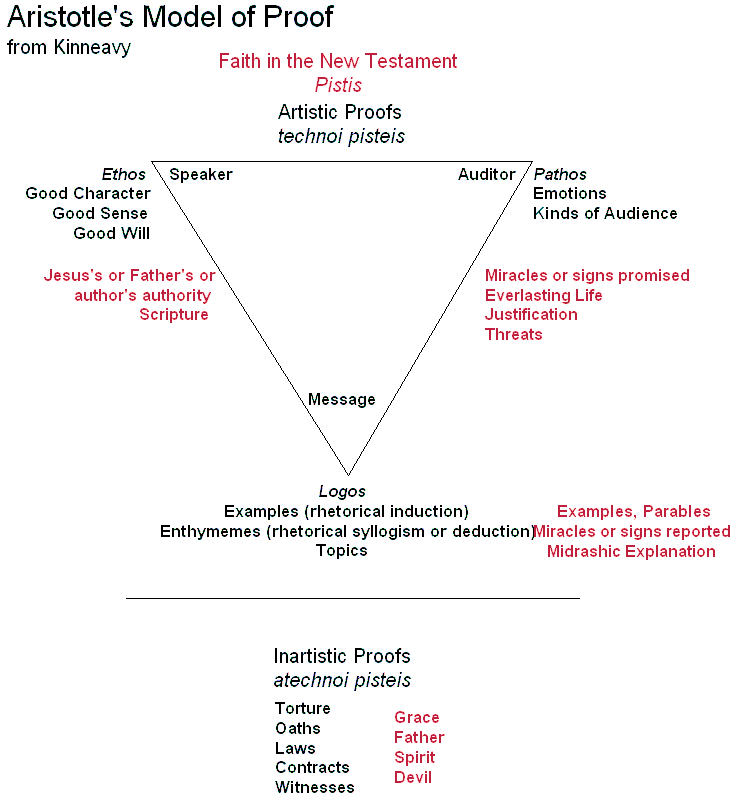
A. The very antithesis of dramatic Pathos is melodramatic Bathos, while the other two main forms of persuasive rhetoric or polemic, beginning from premise, are Ethos which, in the prose of fiction must come through in voice, and Logos which for the purposes of the willing suspension of disbelief or fictional dream, becomes whatever chain of events within rational plausibility, Making The Unbelievable Believable, exploring theme and effectively arguing in support of premise by digging deeper for insight instead of simply pandering to unfair one sided propaganda. In any case, the coherence and impact of ant story depends upon selection of sequence and detail, rationally. In rhetorical plot logic, theme is knowledge-driven Epistemology, and better stories heighten conflict via an opposing or contradictory Counter Premise or Antithesis, sound Hypothetico Deductive Epistemological Methodology, actually seeking refutation rather than only corroboration unopposed.
Because, by every Technique of Suspense plotting, the rising tension and of dramatic conflict signifies that the resolution of whatever the central problem is such as to increasingly press character(s) inevitably to take action in struggle with whoever or whatever the antagonist in some way that must one way or another bring the very values of said character(s) into question for them.
Or, most dramatically, an attempt at howsoever the wiser course may instead press a character into conflict on every level with their own motivating values for which they will be compelled to sacrifice the easier way because the moral course and the more difficult among free willed choices may so often coincide.Plausible characters, like unto real people, require adequate motivation for their deeds and dialogue. Drama is people doing amazing things for very good reasons. But melodrama is just people doing amazing things for bad or utterly nonexistent reasons. In real life, as in drama, true character is revealed in conflict and under pressure to lower ones guard and show, demonstrate, what we are really made of and ever grow.
Plot is not story, and further more, distinguished from narrative [Wayback mirror], or inductively marshalling only the bare "facts" (even if they really are impartial, unvarnished, and not factitiously and unfairly or implausibly slanted, skewed or stacked), simply in the chronological sequence of events. In a plot, additionally, there must be frame and sequence (let alone as any matter of style, sense, time frame or structures, duration, and pacing), the internally consistent and plausible sense and best definable or classifiable chain of causality, from motivated characterization, best achieving dharmic and karmic "unity of action", Sequence and Logic, what happens next and the consequences thereof. Who, What, Where, When, How and Why?
People understand and relate to plot logic the linear causality of stories, even though events in the real world unfold as the confluence of all manner of even dharmic and karmic cofactors in the outcomes of complex systems, perhaps even amenable to some common theme, similarity or generality, if not any other serviceable narrative. Story is what happens, while plot is how. A story is about an issue of human need, value or motivation, but a plot is the mechanics of how that issue will be pursued and acted out to resolution and fulfillment dramatically. Characters need motivation over all. But, more, the plot chain of cause and effect very much includes stimulus and response or: Motivation-Reaction Units. Thoughts and reactions must be revealed and shown, for the story to remain coherent. Hence, problems must motivate not only characters to respond, followed by resultant outcome to which others then react, in Motivation-Reaction Units, but likewise writers to think through their thematic central ideas along with the causal details of plot logic, that are the needs of adequate plotting from coherent premise to plausible conclusion, in order best to retrofit any lingering first-draft-itis...
Because when plot logic misses links, the result is a narrative of seemingly unrelated events. And such omissions, especially off the cuff, are easy, given any complexity, complications, twist and turns that must either be plotted out beforehand or else detected in ongoing critique and reworked in successive rewrites.
A solid plot therefore, to avoid plot-holes, like any strong argument to avoid inconsistency, must weave together the following rhetorical devices:
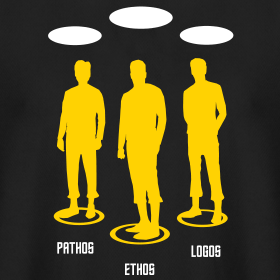
To quote Anthony Burgess: “The nature of a novel is that it has no opinions, only the dialectic of contrary views, some of which, all of which, may be untenable and even silly.”
Ethical appeals employ commonly held values and beliefs; appeals to the logic or pathos of our sense of fairness, right and wrong, justice and mercy, persuasively as pertaining to the real world, or as pertaining to the consistent fictional scenario. Ethical appeals may target either actual people, readers, or, likewise, fictional characters may seek to motivate and persuade one another by appealing to the values of the fictional or historical scenario, milieu or setting.
Polemical appeal not to mention propaganda outright, in plot logic and theme employs, either by demonstration (showing) or by exposition (telling), either such as is generally accepted as true fictionally, though, preferably, without being too blatantly contrived, that is to say, within the plot context of the fictional situation, world or setting, reality as objectively measurable or Empirically corroborated, statistics, authorities, anecdotes, scenarios, case studies, likewise within the same fictional context or back story of the plot.
Indeed, in the most falsely analogous deceptive and manipulative propaganda fiction, that which is generally accepted as true fictionally, especially as it panders vicariously to whatever wish gratification fantasy thinking, may be accepted as actually true in reality by the target audience or readership, even without an explicit claim by the author and despite all blatantly contrary Empirical evidence and logic in reality.
Logical appeals and reasonable statements accepting the burden of evidentiary support hence offering the necessary evidence to support the claim in reality, bald-faced lie about it, or in fiction by the freedom of sheer invention (though, hopefully, not blatantly contrived) for the plot to climax and resolve it's destination or build and support theme, no less than Socratically, as in strictly the legitimate modified form of Ad Hominem, employing, in context, actual, hypothetical, disingenuous or fictitious, either such as is generally accepted as true (even if as often in Science Fiction however outlandish the premise or scenario, no less than in reality when myths and whopping lies well crafted, have entered into common wisdom, such as that is, or by contrast, that comparative rarity, genuinely reasonable common sense), or even reality as objectively measurable or Empirically corroborated, along with statistics, with Ethos which in the prose of fiction must come through in voice, of expertise and numerical data from authoritative sources, established and credentialed experts on whatever the subject but not who's expertise lies in some other area entirely, and hopefully never to be over extended, slanted, skewed or stacked, simply discounting contrary evidence, as with hasty generalizations offering only weak or limited evidence to support a conclusion; asserting a claim on the basis of an isolated example, likewise often constituting a double standard when two or more comparable things are judged according to different standards holding the opposing argument to a higher standard than one's own. Because such will never make a strong argument, a good lie or even a convincingly plausible fiction.
All may ever be deceived or mislead by
logical
fallacy. But for the author to be so, is slipshod if not incoherent. For the
readership or audience intentionally to be, constitutes
manipulative
propaganda. But for
fictional
characters
to be, affords the opportunity for
growth
advancing the plot, even beyond
red
herrings
in mystery.
Knowledge can be of information, cases, skills and processes. "Factual" [sic.] or declarative information is often the easiest to state and to assess and simply therefore often preferred, even though no less often of least practical importance, skills often being found the most difficult to articulate and of greatest practical importance along with processes and cases.
Analogy compares two or more cases or stories, illustratively suggesting that what is true for one is also true for another, including anecdotes, brief stories on a particular occurrence that providing concrete supporting evidence, scenarios, narrative extrapolating hypothetical consequences as they might occur or unfold, or case studies, example previous occurrences meant as general or typical likewise for the purpose of illustration. But beware among the mistakes of fallacious reasoning, gross and subtle. even yet close enough and not generally grave enough to actually forestall reproductive success and wipe out our species. To wit, overextension of inductive argument by analogy, which endured the longest before finally being discredited thereby seemingly concluding the history of logic, unless and until paradox ever holds sway.
Q. And so: What then, is plot?
A. Plot unfolding, is the process of raising, developing and exploring questions as to the outcome in doubt in a scenario. All that rises must converge. Any chain of events, stimuli or triggers even from premise at all, must motivate or illicit response, in turn yielding some plausible yet not too predictable outcome. Indeed, the tightest dramatic plots are surprising as they unfold, yet inexorably necessary in retrospect. Plot: The Fiction Writer's Itinerary, must intertwine three principle threads, any or all unfolding and in doubt, of revelation, the outcome of suspenseful drama, complications, the conflict on many levels that is inherent to situation, action, excitement, spectacle, the whys and wherefores of character growth and pathos, but all together with the meaning of some memorable theme being whatever central question or inquiry, must correlate with some dramatic issue that must be compelling, credible and untenable conflict of values escalating naturally through increasingly high-stakes of any problematic situation.
Sensitivity Analysis is any process to determine how different measures of independent variables each will impact a particular dependent variable under a given set of assumptions and how sensitive a model is to changes in levels of various parameters of the model. In other words: plot variation in futurological scenario planning, projected equilibrium, and their hypothetical probability and likelihood or: plausibility. With background established, disequilibrium sets plot into motion.
Because, by every Technique of Suspense plotting, the rising tension and of dramatic conflict signifies that the resolution of whatever the central problem is such as to increasingly press character(s) inevitably to take action in struggle with whoever or whatever the antagonist in some way that must one way or another bring the very values of said character(s) into question for them. Or, most dramatically, an attempt at howsoever the wiser course may instead press a character into conflict on every level with their own motivating values for which they will be compelled to sacrifice the easier way because the moral course and the more difficult among free willed choices may so often coincide.
People understand and relate to plot logic, the linear causality of stories, even though events in the real world unfold as the confluence of all manner of even dharmic and karmic cofactors in the outcomes of complex systems, perhaps even amenable to some common theme, similarity or generality, if not any other serviceable narrative.
Drama requires characters each with whatever their own motivating stake in the issues, decisions, dire yet at all free choices to make and the looming consequences thereof. And, to build tension and maintain interest and exploit every Technique of Suspense plotting, all attempts to back out must deteriorate and fail, but without such glaring plot holes as blithely overlooked or ignored obvious opportunities.
Plausible characters, like unto real people, require adequate motivation for their deeds and dialogue. Drama is people doing amazing things for very good reasons. But melodrama is just people doing amazing things for bad or utterly nonexistent reasons. In real life, as in drama, true character is revealed in conflict and under pressure to lower ones guard and show, demonstrate, what we are really made of and ever grow.
 "Plot
is the relationship between a number of incidents that shall permit, by its
intersection with a particular character, a dramatic story."
"Plot
is the relationship between a number of incidents that shall permit, by its
intersection with a particular character, a dramatic story."
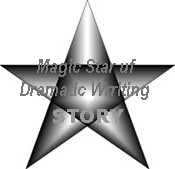 All else in the
logic
of
plotting
scenes
readily follows
from
pertinent decisions what need be
shown
regarding
motivated
characterization
and
conflict on
many
levels with
dramatic obstacles.
All else in the
logic
of
plotting
scenes
readily follows
from
pertinent decisions what need be
shown
regarding
motivated
characterization
and
conflict on
many
levels with
dramatic obstacles.
Plot is not story, and further more, distinguished from narrative [Wayback mirror], or inductively marshalling only the bare "facts" (even if they are impartial, unvarnished, and not factitiously and unfairly or implausibly slanted, skewed or stacked), simply in the chronological sequence of events. In a plot, additionally, there must be frame and sequence (let alone as any matter of style, sense, time frame or structures, duration, and pacing), the internally consistent and plausible sense and chain of causality from motivated characterization, grappling with the dharmic and karmic indefinable classifications of causality and ever best achieving "unity of action", Sequence and Logic, what happens next and the consequences thereof. Who, What, Where, When, How and Why?
Hence, problems must motivate not only characters to respond, followed by resultant outcome to which others then react, but likewise writers to think through the causal details of plot logic, that are the needs of coherent plotting from coherent premise to plausible conclusion.
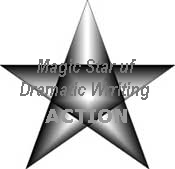 For
every action there is an equal and opposite reaction.
Navigate the various possible
paths and
dead ends and and to
find
stories always
dig
deeper for insight into these engaging and
suspenseful dramatic
questions,
difficult
struggle
vital in sustaining conflict
on many
levels,
tension
and pathos
of
suspense and
anticipation,
even discomfort and
aversion, from the
basic
elements of the plot.
Story is what happens, while plot is how. A story is about an issue of
human need,
value
or
motivation, but a plot is the mechanics of how that
issue will be pursued and acted out to
resolution and fulfillment dramatically. Plot is
dharmic
while drama
is karmic.
For
every action there is an equal and opposite reaction.
Navigate the various possible
paths and
dead ends and and to
find
stories always
dig
deeper for insight into these engaging and
suspenseful dramatic
questions,
difficult
struggle
vital in sustaining conflict
on many
levels,
tension
and pathos
of
suspense and
anticipation,
even discomfort and
aversion, from the
basic
elements of the plot.
Story is what happens, while plot is how. A story is about an issue of
human need,
value
or
motivation, but a plot is the mechanics of how that
issue will be pursued and acted out to
resolution and fulfillment dramatically. Plot is
dharmic
while drama
is karmic.
Events that are not completely unrelated and extraneous may simply follow inevitably from the plot logic unless there is some twist, or be informative of situation, test the character and accrue self knowledge, perhaps even of values, or engage conflict on different levels, even climactically.
Well rounded characters manifest conscious and even false goals often in both inner turmoil as well as practical outer conflict with radically different unconscious desires unawares yet betrayed, demonstrated, shown, by their actions and growth into entirely new goals.
Misdirection, whether error circumstantially and
honestly, by deliberate
manipulation
or even hamartia and
self-deception, is key in moving from
promise to
catastrophe.
Delays, the meticulous progression of tightly interwoven plot
thickening, a
complex plot
with not only dramatic
obstacles to overcome, but diversions and
red
herrings
complications
and
surprise
twists, set backs, shock, surprise, betrayal,
perversion of expectations and other
Peripeteia,
reversals of fortune including
estrangement
plus revelations
exposing and shattering
false
goals priorities
as have been
put forth
and thereby
motivating
entirely new
goals, especially as arising from
character development so as
to change everything, and without which the story would remain predictable. So,
navigate the various possible
paths and
dead ends and and to
find
stories always
dig
deeper for insight into
difficult
struggle.
Because stories are made memorable not merely in whatever
empathy or curiosity
merely as to the plot
situation, but
because of the reader or audience relationship, actual
motivated feelings
elicited for or even against the
characters.
Tautologically, nothing matters unless it matters to somebody somehow. No Powderpuff Pitty-Pat! The tension and pathos, even discomfort and aversion, of suspense and anticipation is heightened with increasing difficulty, the personal emotional stakes are raised, and however character growth is pressed by worsening complications for an active protagonist, definitely including onstage sex! Misdirection, whether error circumstantially and honestly, by deliberate manipulation or even hamartia and self-deception, is key in moving from promise to catastrophe. Navigate the various possible paths and dead ends and and to find stories always dig deeper for insight into difficult struggle.
The traditional components of the story line begin with the preliminaries, establishing the setting and principle characters, the premise and "Act Zero" prior events, as yet unresolved central issues, mysteries, problems and consequences giving rise to the immediacy of all that will be at stake and of vital concern to characters and hence the audience, background information, and all that from which events will unfold into the rising action to be triggered by the inciting incident.
There are different possible foci for any story. And the logic of deconstruction expands and unfurls consistent story elements and variations out from one another. In the rewrites, details reexamined serve as clues to a more rounded story.
In the plot oriented, where in the central issue is a situation, and events serve to drive the narrative forward, Defining the Problem and steering the characters. Indeed, as in much Hard Science Fiction, at it's most cerebral, the entire plot may be driven by solving a problem, most dramatically, a crisis, Visioning, even, exclusively, to the point of deliberately rendering the narrative impersonal. At any rate, beginning from plot development to only thereafter simply people it with characters who can carry out the actions already worked out, always runs the risk wooden and unreal characterization.
For an adventure to begin, a central character must be adequately motivated by any goals ever put forth, whether simply hunger for a quick sandwich, anticipation of a hot date, the allure of a great treasure, or the need for personal closure, even the lust for revenge. The protagonist goes into action, to the kitchen, to the dance club, the far corners of the world or off to an important meeting, but encounters an obstacle, be it an empty bread box, rejection, the forces of darkness in motion, or a sudden and deadly attack. The character responds seeking to overcome the obstacle, heading out to the corner store for a fresh loaf of bread, off to win the heart of the beloved, into a race against the villain for the great prize, striving to come to terms with loss, or hot in pursuit of the failed assassin to learn the reason. But, one way or another, the obstacle is further complicated, becoming greater than it first manifested or only a prelude to an even greater obstacle or even an apparent dead-end. If the protagonist then finds an opportunity to take up the struggle against whatever new obstacle, then the tale may further unfold.
Or, by contrast, as in the first season of 'SLIDERS', stories may be character driven, plot steered by the active intervention of characters, according each to their own motivation, where the dilemma is deeply personal and the rising action is entirely a product of, and dependant upon, unique and deeper individual motivation of a character, and otherwise would unfold quite differently, indeed if at all.
For any character's free choice of strategy will be determined not only by their POV, situation or even entirely mechanistic particular involvement in whatever phase of any process considered, but also defined, guided and constrained by values, into somehow or other principled behavior.
Differing viewpoints upon relationships parallel not only the objective and subjective persons of narrative but also communication and the character interaction of plot and growth.
Moreover, voice and tone afforded motivated character POV (Point Of View) upon situation often turns out more definitive to story in TEXT, CONTEXT and subtext, even than plot variation, because any motivated character's response, reaction or free choice of strategy will be determined largely by their POV or subjectivity, reflection, situation with Representation of consciousness, perspective or even entirely mechanistic particular involvement in whatever phase of any process considered, but also defined, guided and constrained by values, into somehow or other principled behavior.
Now, in either the plot oriented or character driven story foci, people react to events or situation, particularly crises. But motivated characters from unique POV, filtered perceptions and Interpretive Turn, can also also be proactive. Indeed, beyond approach, avoidance and even rising to a challenge, motivated characters may even seek and find challenge or challenge themselves, perhaps even motivated from the need to grow.
Tautologically, nothing matters unless it matters to somebody somehow.
Drama is conflict or contradictions pressing difficult free choices on every level inherent to situation, hence more than merely an event or crisis, but like unto karma, a condition, a relationship. Characters develop out of situation and plot ideas emerge from characters in different situations and the actions undertaken because of their relationships and conflict, the friction entailed as characters come into contact.
Plot derives from the particular reaction, from each their own unique motivations, background and priorities, of characters even to any similar situation, inciting incident or out-of-whack event. Consider, for example, how reaction to finding one's spouse having a drink with a wealthy and well connected business acquaintance might very well differ for an insecure violently jealous ex-con with a bitter personal history of betrayal, a yuppie go-getter clawed up from desperate poverty, a sybaritic wild and horny bisexual or an easy going avid photographer and esthete. -Not to mention how either greater synergy and/or heightened inner or outer conflict on every level might arise from any combination thereof...
But such is only the beginning.
For plot and characterization interplay, such that unique and original well rounded and multifaceted characters may be forced to grapple with their inner conflicts and values in order to come to grips with external problems, hence the inner journey must match the outer journey, beginning from the Emotional Disturbance that is is internal corollary to it's trigger, the inciting incident or out-of-whack event, or vice versa. People often make their most important decisions with their heart but only then rationalize intellectually. Hence, Problem Solving and Justification are reciprocal functions, and one must be shaped to rationalize the other, with integrity or else into hypocrisy.Immediate reactions are often reflexive, but then conscious deliberation ensues upon what action to take next. Or does it? Life can only be lived forwards, but only understood or recognized in hindsight. Indeed, do we consider our options and consciously take action, or do our actions simply come upon us as we react to situation, and only then rationalize afterward? People often make their most important decisions with their heart but only then rationalize intellectually. Hence, Problem Solving and Justification are reciprocal functions, and one must be shaped to rationalize the other, with integrity or else into cognitive dissonance, the inner conflict of dishonest hypocrisy, even as manifest in dialogue as Antiprocess. Frequently, the self conscious illusion of individual will is only the burden of responsibility in hindsight, an artifact of the personal narrative facilitating growth.
And beyond direct action, our influence upon others may often be even the more misguided and deluded.
Some say that one becomes addicted to shame when another's heart is closed to one, because, however excruciating, the sheer megalomania of taking the blame protects one from the ugly truth that we really have no control over others and the universe or God. We can't make either love us or, ultimately, even protect those who do. Put more simply, then, and in complete good faith, powerlessness, the impotent helplessness of the human condition is terminally demeaning.
Goethe identified five types of structural elements in stories (originally in 1797) [Goethe, 1983], and three worlds in which the action takes place: Feeling and reflex must be followed by conscious action or expression. For such are what Dwight Swain dubbed "Motivation-Reaction Units," an even smaller subdivision of action than the scene. For example, a character feels frightened by a sudden threat, and reflexively jumps out of the way. -Or leaps towards an unexpected opportunity! Then the character must consciously decide how to respond, what to do or say next.
Structural Elements
Worlds
Developing the Dark Moment at SAGGING
MIDDLE or midpoint (4-6)
Types of Scenes: The Building Blocks
in plot frame and sequence
Also, Contrast and Correspondences and see: foil...
The Apex of the short story,
which is the high point of the aforesaid story arc of the short story or chapter, is followed by the Reflex, that passage of helpless suspense however excruciatingly long or breathless and brief, in which to await discovery of the resulting consequences in the Climax.
Bonus: The Jungian plot arc
Plausible characters, like unto real people, require adequate motivation for their deeds and dialogue. Drama is people doing amazing things for very good reasons. But melodrama is just people doing amazing things for bad or utterly nonexistent reasons. In real life, as in drama, true character is revealed in conflict and under pressure to lower ones guard and show, demonstrate, what we are really made of and ever grow.
The gap in Behaviorism was never cognitive, but Psychodynamic all along. Behavior, including action and expression or dialogue, is often actually less mediated by cognitive events than by Psychodynamic events, feelings and motivations to be specific, often with inner conflict, in an observable (show: don't tell) cycles of Motivational Reaction Units. Cognition is a rational function of the ego, Phenomenologically manifest in reflection.
1. Decisions arise when new information is inconsistent with one or more currently held goals put forth. The mismatch yields a negative emotion, tension, suspense or stress, producing a rupture in ordinary activity.
of Suspense plotting2. The decision juncture causes a simulation to occur, in which goals as ever put forth are reevaluated on the basis of new information. This evaluation of goals elicits somatic markers.
3. Once the goals put forth are prioritized by somatic markers, new options and new goals are simulated and evaluated, essentially in order to redirect the plot and alter whatever outcome however in doubt!
4. Coherence calculations produce the best option and equilibrium is restored between the present situation and existing goals put forth.
Meaning and importance, all conceivable priorities and values, unless they are one way or another decisively intellectualized, profoundly detached and disengaged in the extreme, ultimately emanate from needs and desires, attraction or aversion, fundamental motivations, selfish or altruistic. Otherwise, there can only be apathy and hence no problems to relate to at all. Deeper motivation, even worldview, characterization, however growth and the philosophical questions of drama, as distinguished by their dramatic gripping inherent conflict on every level, are all contextual function of the human condition or situation that has changed so drastically from the past that is the setting and milieu of historical fiction and into any modern time frame as reflected in contemporary culture, and most certainly will change into the future that is frequently subject matter of Science Fiction and futurological scenario planning.
|
|
But chronological sequence is certainly not
the only presentational strategy of Controlling the Time Line. For example, for a a better hook or grabber, the story may start with a big scene in the middle or in media res, even plot inversion and other variations in the order and frequency of presentation, prose chronological or anachronological, so that the beginning must retrieved, later on, in flashbacks. Also, for the scene to be established from various points of view, the position in sequence of each item may be shifted about or actually shuffled together.Yet the essential components to balance remain fairly constant. However, just as there may be longer chains of events and scenes with successive complications, there may thereby and therefore also be resultant a series of free choices, changes and turning points, in a more elaborate plot.
|
|
Drama is conflict or contradictions pressing difficult free choices on every level inherent to situation, hence more than merely an event or crisis wherein the path however arduous remains clear, but like unto karma, a condition, a relationship.
Stories are made memorable not merely in whatever empathy or curiosity merely as to the plot situation, but because of the reader or audience relationship, actual motivated feelings elicited for or even against the characters who grow out of situation. Hence plot ideas emerge from characters in different situations and the actions undertaken because of their relationships and conflict, the friction entailed as characters come into contact.
The protagonist, or main character, usually the most developed and usually the most sympathetic character, is usually confronted with a problem or conflict any any level and of one type or another, and with choices of free will, at every stage, often including decisions either to advance, stagnate, slow, reverse or exit.
nevertheless, by every Technique of Suspense plotting, the rising tension and of dramatic conflict signifies that the resolution of whatever the central problem is such as to increasingly press character(s) inevitably to take action in struggle with whoever or whatever the antagonist in some way that must one way or another bring the very values of said character(s) into question for them. Or, most dramatically, an attempt at howsoever the wiser course may instead press a character into conflict on every level with their own motivating values for which they will be compelled to sacrifice the easier way because the moral course and the more difficult among free willed choices may so often coincide.
If person vs. person conflict, then the protagonist contends with an antagonist, an opponent or enemy. Believable unique and original well rounded and multifaceted characters and settings, with vivid descriptions and dialogue, help to create a story that readers can relate to. Tension builds as the protagonist makes several unsuccessfull attempts to solve or overcome whatever problem (or skip this step for shorter stories) until reaching a crisis that serves as the last chance for the protagonist to solve whatever problem.
All pushing the protagonist through the widest a range of emotion, in ever deeper and unto their lowest point. And all that follows from, and presses harder upon, and even radically redefines, the central issue and character development along the Character Arc all foreplay (so to speak), building towards the climax which is the point of highest interest or strongest emotional impact, and a crux upon which destiny must turn one way or the other, to delayed fulfillment resolving at long last the promise of the story, expectations, tension and pathos, even discomfort and aversion, of suspense and anticipation continually built up, that have maintained any doubt of the outcome and sustained suspense and anticipation through out until the characters either run out of options or run out of time.
All else in the logic of plotting scenes readily follows from pertinent decisions what need be shown regarding motivated characterization and the many levels of conflict with dramatic obstacles.
Misdirection, whether error circumstantially and honestly, by deliberate manipulation or even hamartia and self-deception, is key in moving from promise to catastrophe. The final event, the height tension as the plot reaches
climax, resolves the dramatic objective that was pursued by both the protagonist and the antagonist. But given any freedom at all, the final choice makes for the dramatic climax, demonstrating and revealing a character's true values and personal code of behavior.In the usual happy ending, the tension of suspense, anticipation and aversion, is resolved as the protagonist succeeds through his or her own intelligence, creativity, courage or other positive attributes. This is usually referred to as the story's climax that may be extend into a resolution phase, a dénouement, by reflecting on the action of the story and its significance to the characters or society.
This standard dramatic formula is known as
the pyramid plot, often in a three-act structure.Another standard plot structure is the hero's journey as in the 4-act paradigm.
Creating Plausible Plots often depends upon possibilities made known to the reader, the choices of free will at every stage, either to advance, stagnate, slow, reverse or exit, that arise for the characters, and an ending that does not remain surprising upon reflection.
Plot and characterization rendered most inextricably:
Indeed,
as literary thought experiment, any character may be fitted into much the same plot or situation, for as much or as little difference as that may come to make to the story over all. Unless characterization and plot are fashioned inextricably, as in the creation of perhaps the most believable characters defined by every aspect of their circumstance and relationships, and when the life events of the character are principle subject, plot, rather than merely preexisting background or color of "Act Zero." After all, plot is nothing but character sketch, exposition, until there is motivation to set events into effect for change.
Plausible characters, like unto real people, require adequate motivation for their deeds and dialogue. Drama is people doing amazing things for very good reasons. But melodrama is just people doing amazing things for bad or utterly nonexistent reasons. In real life, as in drama, true character is revealed in conflict and under pressure to lower ones guard and show, demonstrate, what we are really made of and ever grow.
Whenever motivated characterization logically conflicts on any level with necessary plot contrivance, then either plot and/or characterization must be retailored to fit.
weakness and diagnosisJust as in a character driven story plot arises to serve the character, the more plot driven the story, the more their situation and background, motivation, abilities and resources of the character(s) need to serve that plot. But imperfectly enough to make them interesting and sustain tension and pathos, even discomfort and aversion, of suspense and anticipation by keeping the outcome in doubt, of course!
Or else, in a tragedy, hamartia, the bind error of maladaptation by a character inconveniently mismatched to circumstances (in contrast to the aspect of the hero as more opportunely, appropriately and better equipped, skilled or tempered for whatever challenge at hand), the protagonist's greatest personality flaw or, worse, their greatest virtue, but perhaps in disproportion, leads only to misfortune. Indeed, an entire plot may be derived from any character's emotional core wherein misdirection, whether error circumstantially and honestly, by deliberate manipulation or even hamartia and self-deception, is key in moving from promise to catastrophe. For any character's free choice of strategy is defined, guided and constrained by values, into somehow or other principled behavior. And even the loftiest personal or ideological motivation and most admirable character trait can miss the mark, go astray and awry even upon the proverbial road to Hell that is paved with good intentions, to inspire and then culminate in a cascade of ill considered if not foul deeds outright, tribulation, dissolution, downfall or comeuppance, ruination and disaster.
Indeed, even if thankfully in any somewhat less calamitously heroic proportion, ordinary flawed folk may blindly err, and often prove so much their own worst enemies, that their "inner villain" may provide enough of a dramatic obstacle all on it's own to sustain tension and pathos, even discomfort and aversion, of suspense and anticipation by keeping the outcome in doubt.
Indeed, for a ready challenge in deriving dramatic obstacle from hamartia, take on the schooled fools.
Dramatic Structure
All
of the above are constituents the dramatic structure or conflict type of the plot with it's finer and particular components or points. And all of this applies no less to Romance than to Drama, Comedy or Basic Plotting for Science Fiction.Type of conflict is part of what determines genre. Writing : Plot by by Damon Knight [summarized] deals with plot problem types as classifiable by their motivated goals put forth or endings, while 'A Guide to Mystery Genres' classifies by tone and details of setting, George Polti's classic and still controversial '36 Dramatic Situations (plus one)' classifies inciting incidents or circumstances that will, no doubt, make for an exciting mix and match with the 20 Master Plot Exercises. And Wise Women Discuss—Plot! lists the different basic plots, dramatic structure as defined by interconnection among the types of conflict on whatever level with different obstacles. -Including, of course, conflict with an enemy, the more interesting, however, if the enemy and protagonist share any mixed feelings. Indeed, any good story needs interpersonal conflict even among friends. As with Spock and Bones, probing and bickering. And, especially, as with Spock, inner conflict, ambivalence and angst, with all of the obstacles life provides us to carry with us, inside.
The THEMATIC PREMISE SHEET explains how theme, essential understanding or recurring concept, even as often conveyed via some symbolic Objective Correlative motif or topos, made central, derives conflict and motivation into a truly dramatic plot. And the whys and wherefores are treated in Ten Points on Plotting.
as in Science Fiction, is concerned with putting imagination and premise, extrapolation and problem solving, into the practice of plot development.And, please, no Deus Ex Machina convenient coincidences out of left field! Coincidence shouldn't make things easier. Indeed, far better if the situation and motivation can arise plausibly from the setting, all Elements Of A Successful Story.
Plotting worksheet
The Four C's are Conflict, Complication, Crisis and Climax.
Q. What are complications and subplots?
A. Plot must intertwine three principle threads, any or all unfolding and in doubt, of revelation, the outcome of suspenseful drama, the conflict on many levels that is inherent to situation, action, excitement, spectacle, the whys and wherefores of character growth and pathos, but all together with the meaning of some memorable theme.
Complications build upon, worsen, accumulate and intensify conflict. But for the pressure to thusly mount also requires time and frustration. Retarding plot elements which delay or prolong the action are obstacles, while retrogressive elements which divert action away from resolution of its goals as ever put forth are subplot.
Complications may either arise strategically or logistically from the central problem or be driven by some challenging additional factor, development or obstacle, motivation or concern in the problems of characters, that persists until some turning point in the plot and then return again in the dénouement.
The tension and pathos of suspense and anticipation, even discomfort and aversion, may be necessary for holding the audience while emotional consequence is explored and unfolds. The inner journey must match the outer journey, beginning from the Emotional Disturbance that is is internal corollary to it's trigger, the out-of-whack event, or vice versa. That is why a story walks better on two legs and Plots Come in Pairs that may even be summarized in a great log-line. To seduce the reader, through out the story, in fulfilling one anticipation the next anticipation has already been whetted, to keep'm hanging.
Life can only be lived forwards, but only understood or recognized in hindsight.
Some say that one becomes addicted to shame when another's heart is closed to one, because, however excruciating, the sheer megalomania of taking the blame protects one from the ugly truth that we really have no control over others and the universe or God. We can't make either love us or, ultimately, even protect those who do. Put more simply, then, and in complete good faith, powerlessness, the impotent helplessness of the human condition is terminally demeaning.
Indeed, do we consider our options and consciously take action, or do our actions simply come upon us as we react to situation, and only then rationalize afterward? People often make their most important decisions with their heart but only then rationalize intellectually. Hence, Problem Solving and Justification are reciprocal functions, and one must be shaped to rationalize the other, with integrity or else into hypocrisy. Frequently, the self conscious illusion of individual will is only the burden of responsibility in hindsight, an artifact of the personal narrative facilitating growth.
And beyond direct action, our influence upon others may often be even the more misguided and deluded.
Some say that one becomes addicted to shame when another's heart is closed to one, because, however excruciating, the sheer megalomania of taking the blame protects one from the ugly truth that we really have no control over others and the universe or God. We can't make either love us or, ultimately, even protect those who do. Put more simply, then, and in complete good faith, powerlessness, the impotent helplessness of the human condition is terminally demeaning.
Misdirection, whether error circumstantially and
honestly, by deliberate
manipulation
or even hamartia and
self-deception, is key in moving from
promise to
catastrophe.
Delays, the meticulous progression of tightly interwoven plot
thickening, a
complex plot
with not only dramatic
obstacles to overcome, but diversions and
red
herrings
surprise
twists, set backs,
Peripeteia, shock, surprise, betrayal,
perversion of expectations,
social
estrangement and other
reversals of fortune including revelations
exposing and shattering
false
goals and
priorities
put forth
and thereby
motivating
entirely new
goals, especially as arising from
character development so as
to change everything, and without which the story would remain predictable. So,
navigate the various possible
paths and
dead ends and to
find
stories always
dig
deeper for insight into
difficult
struggle.
Well rounded characters manifest conscious and even false goals often in both inner turmoil as well as practical outer conflict with radically different unconscious desires unawares yet betrayed, demonstrated, shown, by their actions and growth into entirely new goals.
Drama is conflict or contradictions, pressing difficult choices on the many levels inherent to situation, hence is more than merely an event or crisis, but like unto karma, a condition, a relationship. Characters develop out of situation and plot ideas emerge from characters in different situations and the actions undertaken because of their relationships and conflict on many levels, the friction entailed as characters come into contact.
Prolong the Agony by making life difficult so as to motivate characters. Even pander to vicarious wish fulfillment, but also inspire pathos, anticipation, suspense even dread and even the discomfort of sheer aversion. Stir any range of emotions and force the reader to empathize, to feel. That's what makes for good entertainment, a real page turner.
Throughout the plot, the tension and pathos, even discomfort and aversion, of suspense and anticipation is heightened as things are made more difficult, the personal emotional stakes are raised, and character development is pressed by worsening complications for an active protagonist, definitely including onstage sex! Navigate the various possible paths and dead ends and to find stories always dig deeper for insight to the struggle.
Further and mounting complication may be introduced by way of subplots, and examples of subplots include any separate exploits of secondary characters, focus upon individual problems as a consequence of whatever vast and/or pivotal events, the separate and distinct personal crises of a supporting characters necessarily pressed to resolution in order to cope with and play into whatever larger issues of the leading plot, interrelated or separate but one way or another parallel, or even zipper stories consisting of alternating strands, beginning apparently unrelated until over whatever time frame or structures, duration, and pacing, closing together and finally connecting into the story climax.
The purpose of any subplot may be two-fold, either to enhance a character, theme, plot, or amplify part of whatever genre, or to move the course of the main story as defined by the leading plot, in a direction which it could not proceed in and of itself otherwise. Subplots may relate to leading plots, but without carrying forward, strengthening, or explicating that main action. nevertheless, different circumstances may influence one another as contributing causes to the outcome, but each also requiring explanation and development. Hence the plot as a whole may culminate as an aggregate of intertwining subplots.
Main plot and subplot are traditionally known as A, B, and C plots. And as circumstances and motivation evolve in through the story, or even transition in POV, leading and subplots may advance, recede and trade places in priority.
There are many important purposes served by subplots.
A standard plotline is that of the uncertain tribulation of romance until happy resolution. And as a common subplot, this becomes the development of a a relationship, an alliance necessary to further the main plot.
Life can only be lived forwards, but only understood or recognized in hindsight. Indeed, do we consider our options and consciously take action, or do our actions simply come upon us as we react to situation, and only then rationalize afterward? People often make their most important decisions with their heart but only then rationalize intellectually. Hence, Problem Solving and Justification are reciprocal functions, and one must be shaped to rationalize the other, with integrity or else into hypocrisy. Frequently, the self conscious illusion of individual will is only the burden of responsibility in hindsight, an artifact of the personal narrative facilitating growth.
And beyond direct action, our influence upon others may often be even the more misguided and deluded.
Some say that one becomes addicted to shame when another's heart is closed to one, because, however excruciating, the sheer megalomania of taking the blame protects one from the ugly truth that we really have no control over others and the universe or God. We can't make either love us or, ultimately, even protect those who do. Put more simply, then, and in complete good faith, powerlessness, the impotent helplessness of the human condition is terminally demeaning.
Desperate as hostile and cognitively dissonant bullies typically are for Existential Validation in all disregard of sanity and reality, indeed only a complete amoral sociopath is ever surprised that harm done without regard to others may injure good will in return. But all first impressions tend to uncomplicated objectification, the stimulus response of selfish desire and gratification, for advantage, amusement, comfort or sex or else threat, revulsion and avoidance.
Rather, it is the individual baggage of characterization that complicates. And the first question is neither of intimacy nor distance, but zero-sum versus non-zero-sum. Why, just possibly, even a most deadly enemy may be intimidated into keeping out of one's way in return for likewise, barely forestalling dramatic resolution to inevitable zero-sum conflict for advantage at the other's cost, even to the ultimate.
Why, then, must dearest lovers compromise and sacrifice all that is of real meaning? Why, only for a codependent false sense of security. Such are controlling fear based relationships. A zero-sum relationship is one in which the parties each gain only from what the other gives up, but non-zero-sum denotes productively actually coming out ahead. Reciprocal gains without reciprocal cost. Indeed, ultimately, true love should be free to Altruism, advancing the interests of the beloved, and deserves reciprocation. And so, what must accrue, lofty romantic perseverance and illusion, vulgar and cynical tit-for-tat, even jeopardy of the complete breakdown of trust? Indeed, the shortest distance, the straight line, is the least common path to any happy ending, if at all. Nor will anything so simple, with no obstacle or complication to keep the outcome in doubt, ever make for drama, only pandering at best.
Indeed, virtually all relationship of whatever kind go though stages, with choices at every stage, either to advance, stagnate, slow, reverse or exit, all beginning with some sort of first discovery, romance even courtship, so to speak, even "the honeymoon," but cannot omit inevitably coming into conflict on many levels, misunderstanding, insecurity, power struggle, friction which is normal and even healthy (not to mention more dangerous obstacles of passion as denial, jealousy and anger), and in order to survive must reach acceptance in order to commit to substantive cooperation and even full collaboration or else progressively dissolve and fail, all the harder from which to recover.
Innovative subplot complications and scenes pioneered by Joss Whedon on 'Buffy the Vampire Slayer' and 'Angel' include the following:
NEXT:

Q. Where is to be found the deeper meaning in fiction?
Q. What about pacing and style?
Not just punctuation and clear presentation, but various extensive and dynamic "show don't tell", 'voice' and Point of View techniques, tips and pointers...
Writing
Great
Dialogue
 Q.
What
is the speculative element crucial and unique defining
Science
Fiction
that may even challenge or even violate, outright, so many of the writing
values, maxims and
priorities traditionally central
fiction writing?
Q.
What
is the speculative element crucial and unique defining
Science
Fiction
that may even challenge or even violate, outright, so many of the writing
values, maxims and
priorities traditionally central
fiction writing?
A.
Q. Any additional more specific and over all follow up advice about fiction writing?
A. After a quick review of the fundamental elements of fiction, follow The 39 Steps: A Primer on Story Writing and be sure to drop by Writers Studio 2 and take the Strange New Worlds Hints, then ponder the Aphorisms for Writing Science Fiction and consult A checklist for critiquing Science Fiction while ordering in fluent Literary and Rhetorical Terms from the Pure Fiction Writing Menu, and consider the Hardcore Critique Guidelines about How to Critique Fiction when Reading Fiction and then Writing about Fiction.
Q.
Is there any recommended linked resource offering pointers on good Science Fiction writing technique?A. Browse Constructing an SF Universe.
Q. What is all this STAR TREK crap?
A. There is nothing wrong with 'Star Trek' except bad writing, and seldom ever anything right with 'Star Trek' that does not begin with good writing. Same as with anything else...
So, why fanfic? Because Television provides a convenient modern folklore familiar to all.
Q.
But what if I ever hope to be published?A. Obviously, fanfic is in all likelihood, inherently unpublishable, given whatever issues of prior intellectual property. Because the publication of fanfic is only ever tolerated in whatever limited exposure and amateur context.
And so, going beyond whatever pure calling or sheer amusement and edification of fiction writing just for it's own sake, and given any motivating goal ever put forth of professional publication, fanfic can ultimately be no more than a brainstorming point of departure, purely an exercise to ultimately feed into all new projects concurrently or later on that will be unencumbered by bothersome restrictions upon prior intellectual property.
And, indeed, a selection of all new concepts are already also to be found included along with the fanfic in the collaborative fiction brainstorming unfinished fiction menu.

Beginning with the outline for introductory six part mini-series
also serving as series "bible" for Star Trek: The Ship of Fool, no effort has been spared by glossing over that which is merely perfunctory and dull. Nothing should be included unless it is interesting, provocative or dramatic. To provide new and colorful motivated and even unique and original well rounded and multifaceted characters, and to speculatively advance the ramifications, or at least take over the top rather than simply rehash or further trivialize, the most appealing STAR TREK tropes.And that Star Trek: The Ship of Fools outlines and drafts are truly unfinished, with much to be added and changed, rich with points of creative departure for anyone to join right in a real ongoing online writer's bull session. Not just dullardly anal formulaic filling in of the blanks with the obvious simply for the sake of completion in immersive detail, even however arbitrarily.
Q.
Why
the
title?
A.
The Ship of Fools, sacred fools, is a classical allegory of the human condition, blind and impulsive in hopes of salvation. And ‘Star Trek: The Ship of Fools’
is a tale of encounter with the unknown from Rashuman-like multiple perspective,
and corresponding dramatic
conflict from clashing
motivation.
Hieronymus Bosch • Annotated • schooled fools • yellowdog
Copyright 2001 - 2023 by
Aaron Agassi