
`





 There
are many different approaches to overcoming writer's
block. This page, in particular is not about
any damn goody two shoes
worst advice disciplined working habits and environment or
dreary procedures of
Behavior Modification and self
manipulation, but anything far more
enjoyable; specifically, the range fiction writing creativity
techniques, aids and various
Oblique Strategies even at random. The only thing that'd make everything even more
fun and
productive, would be
trying them out together!
There
are many different approaches to overcoming writer's
block. This page, in particular is not about
any damn goody two shoes
worst advice disciplined working habits and environment or
dreary procedures of
Behavior Modification and self
manipulation, but anything far more
enjoyable; specifically, the range fiction writing creativity
techniques, aids and various
Oblique Strategies even at random. The only thing that'd make everything even more
fun and
productive, would be
trying them out together!
A.
Whether struggling alone or sharing inspiration in collaboration as in the open common projects on this very site, one salient point to bear in mind is that even though a finished plot must generally be linear, in the activity of fiction writing and the process of plotting probably should not be, perhaps, unless the story readily unfolds from premise. - Especially in Science Fiction, and even after deploying the futuring methods of Futurology.All else in the logic of plotting scenes readily follows from pertinent decisions what need be shown regarding motivated characterization and every level of conflict with dramatic obstacles. Indeed, even the world-building details of setting may derive plot.
Storycraft: IDEAS into PLOT as in Science Fiction, is concerned with putting imagination and premise, extrapolation, defining and solving problems into the practice of plot development. Being naturally construed in terms of what they are likely to do, characters may also be derived from their function in the plot as they are introduced and reintroduced. And by the logic of deconstruction, consistent story elements and variations expand and unfurl out from one another. In the rewrites, details reexamined serve as clues to a more rounded story.
For there are stories that unfold in full, just tumbling forth, relentlessly and at a breathless pace, from a compelling premise, one so vastly consequential in it's myriad ramifications that quite literally makes every difference and just won't let go. But, otherwise, what if the premise only goes so far on it's own?
In such case, even fully capitalizing upon the situation unfolding from the premise, at some point the plot must begin to evolve beyond the initial concept in order to sustain interest, best achieved via an unexpected development in a relationship, a surprise plot complication, twist, Peripeteia such as estrangement, or by the addition of any new motivating goals ever put forth and/or added obstacle. Misdirection, whether error circumstantially and honestly, by deliberate manipulation or even hamartia and self-deception, is key in moving from promise to catastrophe. Explore alternate scenarios if only to escape the obvious.
Characters need to be at all up to their challenges, but only barely. No Powderpuff Pitty-Pat! Prolong the Agony by making life difficult so as to motivate characters. Even pander to vicarious wish fulfillment, but also inspire pathos, anticipation, by every Technique of Suspense plotting, even dread and the outright discomfort of sheer aversion. Stir any range of emotions and force the reader to empathize, to feel. That's what makes for good entertainment, a real gripping page turner. To propel conflict, the Protagonist and Antagonist characters must display complementary psychologies such that the motivating desires and intentions of the Protagonist are bound to arouse the motivating fears of the Antagonist, and vice versa. Throughout the plot, the tension and pathos, even discomfort and aversion, of every Technique of suspense in plotting, building tension and anticipation, are all heightened as thing are made more difficult, the personal emotional stakes are raised, and character growth is pressed by worsening complications for an active protagonist, definitely including onstage sex! Virtually all relationships of whatever kind begin with some sort of first discovery, romance even courtship, so to speak, even "the honeymoon," but inevitably and come into conflict on different levels, friction which is normal and even healthy, and in order to survive must reach acceptance in order to commit to substantive cooperation and collaboration.
“Thoughts are the shadows of our feelings - always darker, emptier and simpler.” — Friedrich Nietzsche
And there are various techniques by which to chose and then show events unfolding in scenes and half scenes or vignettes.
Write out your raw material, organize it, rewrite, revise and then proofread. There are many different Writing Strategies and approaches. Even without clue or qualm as to the shape of the finished work, consider the write ideas for the technique of the pod story that begins first in writing scenes, even mind mapping or Clustering vignettes and allowing an ever clearer picture unfold in the imagination over time and flesh out the scene and characterization with more scenes culminating into an entire back story which becomes the plot. Indeed, there is agreeable related application of Improv.
Complexity and depth help draw in the audience. Explore alternate scenarios if only to escape the obvious. Navigate the various possible paths and dead ends and to find stories always dig deeper for insight into difficult struggle. Draw connections and string together multiple elements, to arrange and rearrange the storyboarding components one already has, in order to then understand the implications and fill in the blanks, perhaps, as may often be beneficial when faced with writers block, by brainstorming, even from random stimuli, an Affinity Diagram according to the Kawakita Jiro method. Indeed, techniques of Strategic Planning may even be redeployed for charting the interlocking details of an involved plot.
To achieve Writer's Unblock, first recognize where the block lies. Organization like corrections, only comes after at all jotting down anything whatsoever to correct or reorganize in the first place. So, if unclear even where to start, Begin With the End or even envisage the publicity materials and work backwards! Screw around.
The rôle-play techniques of Improv are made use of to help flesh out situations into motivated dramatic scenes, and are among the 15 Tips To Help You Move Forward.
Observe dramatic economy. Eliminate needless redundancy, Use it or loose it! Many works of fiction in progress pitter out and grind to a halt for want of any clear story direction, as yet.
What to do when the author has painted themselves into a corner or when the story has exhausted itself? What can go badly wrong is to fall back upon overblown cliché of pointless unlikely revelations and new uninteresting and poorly motivated enemies for impersonally huge battles thus loosing all distinctiveness of the story. And the simplest alternative is simply to end the story when it can move no further forward.
But even that may seem predictable and disappointing.
Or with a plot twist, obstacle, complication, Peripeteia, or estrangement, the story can change direction entirely.
But perhaps most deft will be throughout, by rewriting backwards to prepare the third act, to move characters into some however modified situation that will propel the story when all else is spent, for example, by the emergence of new and further ramifications, by developing supporting characters complete with preexisting relationships, to take central stage to replace principle characters making their exit, or additional developments sowing confusion and affording the perpetrator a new alibi just in the nick of time, and so on and so forth.
Prolong the Agony by making life difficult, so as to to motivate characters. Even pander to vicarious wish fulfillment, but also inspire pathos, anticipation, suspense even dread and even the discomfort of sheer aversion. Stir any range of emotions and force the reader to empathize, to feel. That's what makes for good entertainment, a real page turner.
“Thoughts are the shadows of our feelings - always darker, emptier and simpler.” — Friedrich Nietzsche
So, don't be nice to your character! No Powderpuff Pitty-Pat! Throughout the plot, the tension, even discomfort and aversion, of suspense, anticipation and pathos, is heightened by increasing difficulties, the personal emotional stakes continually raised, and character growth is pressed by worsening complications for an active protagonist, definitely including onstage sex! So navigate the various possible paths and dead ends and to find stories always dig deeper for insight into difficult struggle.
Less is more: "Leave out the bits that people just skip ahead." — Elmore Leonard
One way or another, anything else important or desired can be added but only without loss of
focus into anything becoming extraneous, including
complications,
subplots,
secondary
characters.
Insufficient build up of
tension, failure to continually raise the stakes,
every
level
of
conflict and
tension,
will result in too high a low point, not deep enough a hole to dramatically
force the protagonist to a realization of taking action.
The
characterization may even
be well rendered and
motivated, but
the
inciting incident
giving rise to
conflict on any
level
at all, is still
missing.

Or the plot, the causal sequence of events needed to bring the characters to the climactic conclusion of the story is not adequately thought out, and needs to be better worked through even according to an agenda. Indeed, perhaps the author has created too difficult an obstacle for the characters to overcome, or even backed the protagonist into a corner, with no escape save by resorting to the most contrived solutions. In such case, the tools, characters and situations can be plausibly altered or added in a simple reedit, going back through the story to add whatever necessary props including Chekhov's gun, as may be needed later on.
Indeed, whereas journalism and history generally rely upon expository summary, the narrative of fiction can be rendered from sources and inspiration in reality and elaborated into imaginative details of action and dialogue in order better to "show, don't tell."
First and foremost, plot is your enemy.
So if all else fails, force yourself to sit and draw stick figures and write simple declarative sentences. Or try these exercises.
Fresh ideas for writing can be gleaned from news and non fiction, reverie, dreams, personal life experience, by drinking in the setting, astute measure of situation, skillful observation in the study of human behavior, yes, people watching and then spinning fantasy or even by eavesdropping outright.
And, in case the author struggles with a message, the THEMATIC PREMISE SHEET explains how theme, essential understanding or recurring concept, (such as nay be conveyed via some symbolic Objective Correlative motif or topos), when made central, can bring together the other elements, such as conflict on every level with motivation, into a truly dramatic plot with any pathos. Indeed, many a classic theme is reducible to proverb.
Raising the emotional stakes for characters may heighten drama on the page, if convincing but melodrama if not, even as inspired by the inner conflict of the author. Unless, alas, the author is paralyzed from writing on the level of personal inner conflict. In such case, actually lowering the emotional stakes for oneself and confronting unrealistic expectations may help in unblocking the flowing creativity. Because, if unfiltered notions still will not seep into mind and pour out onto the page, indeed, in case writer's block indeed arises from a dearth of ideas such as might meet whatever personal high standard or aspiration, then one simple cure for writer's block may be simply to lower one's standards, even to admit (or perhaps even rescue and resuscitate) Horror and Other plots we see too often.
|
Type of conflict is part of what determines genre. Writing : Plot by by Damon Knight [summarized] deals with plot problem types as classifiable by whatever their motivated goals ever put forth or story endings, while 'A Guide to Mystery Genres' classifies by tone and details of setting, George Polti's classic and still controversial '36 Dramatic Situations (plus one)' classifies inciting incidents or circumstances that will, no doubt, make for an exciting mix and match with the 20 Master Plot Exercises. And Wise Women Discuss—Plot! lists the different basic plots, dramatic structure as defined by interconnection among the levels of conflict with different obstacles. -Including, of course, conflict with an enemy, the more interesting, however, if the enemy and protagonist share any mixed feelings. Indeed, any good story needs interpersonal conflict even among friends. As with Spock and Bones, probing and bickering. And, especially, as with Spock, inner conflict, ambivalence and angst, with all of the obstacles life provides us to carry with us, inside.
Indeed, even random clichés may be utilized for Stupid Plotting Tricks.
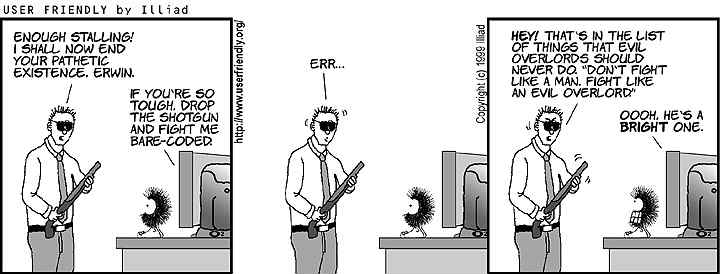
Yes, one can always fall back on stock plotlines or even The Well-Tempered Plot Device! And learn how to create a conspiracy theory in 4 easy steps. Of course, such may do little justice to any even remotely intriguing premise. Indeed, without some twist, a standard plot may only be the more compelling if there are intriguing variations upon it's stock elements.
After sufficient experience in imitation, individual preference emerges to begin shaping distinct style, the writer's restless dissatisfaction finally bearing fruit. A happy ending, at last, to the dire tribulation of writer's block.
Better still, consult the excellent companion list of The Things I Will Do if I Am Ever the Sidekick. Although, it isn't always the heroes who just can't find good help! By whatever circumstance or obligation, tragic mobsters or warlords are frequently overtaken by events running out of control, no thanks to trusting, against all better judgment, angry, callow, stupid complex and well motivated henchmen, often family or in-laws, who disregard all cautionary instructions against opportunism or vengeance, thereby thwarting the sagacious tragic mobster or warlord's confident and carefully laid plans and efforts towards victory, the perfect crime, or even at averting bloody catastrophe by careful strategy and tough but fair minded negotiation. An excellent standard plot or subplot, depending upon who is the central character. Indeed, if whatever sort of protagonist is too sensible and moderate, there can always be any of the supporting cast more impulsive and foolish in whatever conceivable ill considered motive, for any warning to the wise to go unheeded, one way or another.
In any case, if the story must turn upon disregarded obvious good advice, then then in a character driven story, such events must turn upon strong motivation, either pigheaded or highly principled or both at once or even hamartia. Or in a complex plot oriented story, in a plot digression the wiser course is first attempted but somehow thwarted by circumstance. Or, most dramatically, an attempt at howsoever the wiser course may instead press a character into conflict on every level with their own motivating values for which they will be compelled to sacrifice the easier way because the moral course and the more difficult among free willed choices may so often coincide.
G. E. Moore derided the very notion of ethics ever founded upon scientific principles, as: the naturalistic fallacy, because ethics strives to define what ought rather than what is. Thus science, he claimed, can’t get an “ought” out of an “is." After all, philosophy has never actually produced a falsifiable assumption for ethics. Only given any moral premise can scientific investigation up to any point, ever shed light upon possible and likely consequences of behavior informing responsibility towards whatever choices free to us.
If there is a God who keeps His own secrets, withholding certainty only unto Himself, then, likewise, Godlike responsibility can solely be for God alone, and by design. Hence it can only be the human struggle from from uncertainty with human responsibility, within the fallibility of all as much and as little that is given us to know, that will ever be pleasing to God, a passionately uncertain struggle " . . . since the possible number of actions in the universe is unlimited -- as is the number of possible situations from which actions may proceed and take their tone -- morality is ... too complex to be knowable and far too complex to be reduced to any code . . ." - John Gardner, On Moral Fiction
After all, getting things right is seldom so simple as it sounds, and frequently takes some doing. And so, there may still be a story in there...
Best usage of the illustrated story generator
Random Science Fiction Story Ideas
 Writing flash fiction using bubble diagrams is an application of
Mind Mapping
to creative writing. For this purpose,
Hatch's Plot Bank or the
Random
Story Starter can be supplemented with the Random
Character Maker and Random
Character Namer or
DADA's
Little Baby Namer,
city names, too.
Name, Name, Who's Got the Name?
Analyze names,
even pets!
Or just click the
Random Logline Generator!
Writing flash fiction using bubble diagrams is an application of
Mind Mapping
to creative writing. For this purpose,
Hatch's Plot Bank or the
Random
Story Starter can be supplemented with the Random
Character Maker and Random
Character Namer or
DADA's
Little Baby Namer,
city names, too.
Name, Name, Who's Got the Name?
Analyze names,
even pets!
Or just click the
Random Logline Generator!
And find much more at the
Seventh
Sanctum and


A common subplot is the development of a relationship, an alliance necessary to further the main plot. Virtually all relationships of whatever kind begin with some sort of first discovery, romance even courtship, so to speak, even "the honeymoon," but inevitably and come into conflict on every level, friction which is normal and even healthy, and in order to survive must reach acceptance in order to commit to substantive cooperation and collaboration.
Keep dialogue short, snappy, interactive, dynamic, subtle, meaningful but simple

|
|
Hard as silicon on the outside, yet mushy to the core, this permanently inspired romance scribe turns out torrid but touching tales of true love. Bring your own violins. |
THE HENTAI Tarot for your Kisekae set kiss player FREEWARE.
The story arc applied to common Romance plot scenarios

Setting, the environment or milieu, can also be crucial on shaping personality or characterization, and may actually be made central in the writing techniques known as world-building.
The virtual lit interactive tutorial exercises cover all The Formal Elements of Fiction
  |
<The instructions on the Story Generator page, however, omit to explain perhaps the most important and uniquely powerful features of this fantasy quest oriented tool, namely, the check boxes, to be used separately or together:
Indeed, for just such added dimension, additional prosaic story elements of more sophisticated literary narrative and even a proper thematic hint can be supplied by judicious utilization of the
Instant Muse Story Starter. The
Tarot.
The
Tarot.

Instant Fairytales:
Try Making Fairy Tales from Personal Stories or select your functions to enter into the
proppian fairy tale generator. Also, the Do-It-Yourself Fairy Tale Kit has been automated as the Fairy Tale Generator 2.0.
Character Analysis: "Given Circumstances" of Situation
Character Portraits: Record The Inner Person
Fiction Writer's Character Chart
| Detailed Character Inventory |
Click on the 'Workplates'
tab on the
 Homepage
and then select one of three areas
to explore: Historical, Psychological, and
Relationships. Then,
complete the detailed questionnaires on the
character's behalf.
Homepage
and then select one of three areas
to explore: Historical, Psychological, and
Relationships. Then,
complete the detailed questionnaires on the
character's behalf. |
Applying time and project management to fiction writing with a unique emphasis regarding
Q. Where is to be found the deeper meaning in fiction?
Q. What about pacing and style?
Not
just punctuation and clear presentation, but various extensive and dynamic "show don't tell", 'voice' and Point of View techniques, tips and pointers...
 Writing
Great
Dialogue
Writing
Great
Dialogue
Q. Any additional more specific and over all follow up advice about fiction writing?
A. After a quick review of the fundamental elements of fiction, follow The 39 Steps: A Primer on Story Writing and be sure to drop by Writers Studio 2 and take the Strange New Worlds Hints, then ponder the Aphorisms for Writing Science Fiction and consult A checklist for critiquing science fiction while ordering in fluent Literary and Rhetorical Terms from the Pure Fiction writing menu, and consider the Hardcore Critique Guidelines about How to Critique Fiction when Reading Fiction and then Writing about Fiction.
 Q.
What
is the speculative element crucial and unique defining
Science
Fiction
that may even challenge or even violate, outright, so many of the writing
values, maxims and
priorities traditionally central fiction writing?
Q.
What
is the speculative element crucial and unique defining
Science
Fiction
that may even challenge or even violate, outright, so many of the writing
values, maxims and
priorities traditionally central fiction writing?
A.

Q.
Is there any recommended linked resource offering pointers on good Science Fiction writing technique?A. Browse Constructing an SF Universe.
Q. What
are the different options and their pitfalls, in various approaches to fiction writing and collaboration? And what better alternatives are there?A.
Here is an Overview as to why, quite frankly, we'd all be best off brainstorming.STAR TREK crap? A. There is nothing wrong with 'Star Trek' except bad writing, and seldom ever anything right with 'Star Trek' that does not begin with good writing. Same as with anything else...
So, why fanfic? Because Television provides a convenient modern folklore familiar to all.
Q.
But what if I ever hope to be published?A.
Obviously, fanfic is in all likelihood, inherently unpublishable, given whatever issues of prior intellectual property. Because the publication of fanfic is only ever tolerated in whatever limited exposure and amateur context.And so, going beyond whatever pure calling or sheer amusement and edification of fiction writing just for it's own sake, and given any motivating goals ever put forth of professional publication, fanfic can ultimately be no more than a brainstorming point of departure, purely an exercise to ultimately feed into all new projects concurrently or later on that will be unencumbered by bothersome restrictions upon prior intellectual property.
And, indeed, a selection of all new concepts are already also to be found included along with the fanfic in the collaborative fiction brainstorming open projects menu.

Beginning with the outline for introductory six part mini-series
also serving as series "bible" for Star Trek: The Ship of Fool, no effort has been spared by glossing over that which is merely perfunctory and dull. Nothing should be included unless it is interesting, provocative or dramatic. To provide new and colorful motivated and even unique and original well rounded and multifaceted characters, and to speculatively advance the ramifications, or at least take over the top rather than simply rehash or further trivialize, the most appealing STAR TREK tropes.And that Star Trek: The Ship of Fools outlines and drafts are truly unfinished, with much to be added and changed, rich with points of creative departure for anyone to join right in a real ongoing online writer's bull session. Not just dullardly anal formulaic filling in of the blanks with the obvious simply for the sake of completion in immersive detail, even however arbitrarily.
Q.
Why the
title?
A. The
Ship of Fools,
sacred fools, is a classical allegory of the human condition, blind and
impulsive in hopes of salvation. And
Star Trek: The Ship of Fools is a tale of encounter with the unknown from Rashuman-like
multiple perspective, and corresponding
dramatic
conflict on
many
levels from
clashing motivation.
Hieronymus Bosch • Annotated • schooled fools • yellowdog
Copyright 2001 - 2013 by
Aaron Agassi